BUILD
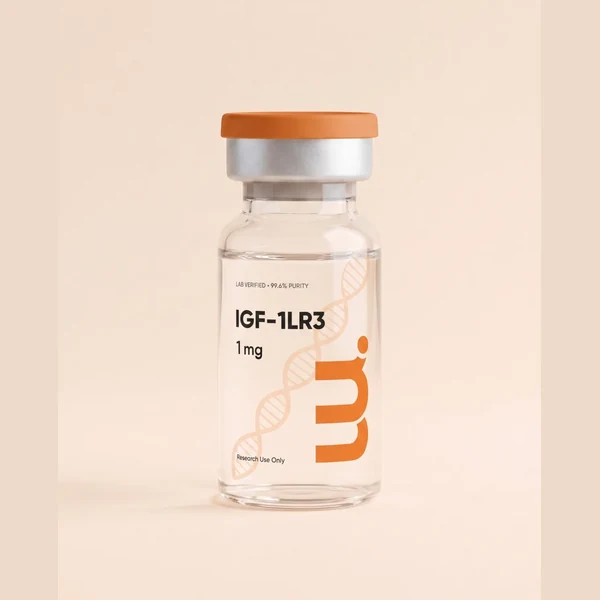
IGF-1 LR3 1mg
IGF-1 LR3
€209.00
Purity ≥99% · verified by HPLC and mass spectrometry
Order via TelegramThe report for the lot that would ship to you is issued on request, before payment.
Tracked shipping to the United Kingdom, Ireland and the rest of Europe · handling 0–1 days · 14-day right of withdrawal
Technical specification
| CAS number | 143045-27-6 |
|---|---|
| Sequence | |
| Molecular formula | |
| Molecular weight | 9117.6 g/mol |
| Purity | ≥99% |
| Presentation | Lyophilised powder, single-use glass vial |
| Intended use | Laboratory research use only |
IGF-1 LR3 (Long R3 IGF-1) is an 83-amino-acid recombinant analogue of human insulin-like growth factor 1, engineered with a glutamate-to-arginine substitution at position 3 and a 13-amino-acid N-terminal extension. These modifications reduce binding to IGF-binding proteins, extending the molecule's bioavailability in cell culture and animal research relative to native IGF-1.
The literature on IGF-1 LR3 spans cell-signalling research into the IGF-1-receptor/PI3K/Akt pathway, in vitro studies of cell proliferation, and animal research examining growth-factor signalling. Because reduced IGF-binding-protein affinity simplifies experimental dosing in vitro, IGF-1 LR3 is a frequently used research tool in cell-culture systems studying IGF-1 receptor activity.
Research applications
- IGF-1 receptor / PI3K / Akt signalling pathway research
- In vitro cell proliferation and differentiation studies
- IGF-binding protein interaction research
- Comparative growth-factor signalling studies in animal models
What the literature reports on IGF-1 LR3
Native IGF-1 activity in vivo and in cell culture is substantially modulated by a family of IGF-binding proteins (IGFBPs), which sequester the growth factor and limit receptor engagement. IGF-1 LR3 was engineered specifically to reduce IGFBP affinity while preserving IGF-1 receptor binding, a design documented in the original biochemistry literature describing Long R3 IGF-1 analogues.
Cell signalling research
In vitro studies using IGF-1 LR3 have characterised downstream activation of the PI3K/Akt and MAPK/ERK signalling cascades following IGF-1 receptor engagement, using the reduced IGFBP interference of this analogue to obtain more consistent dose-response data than is typically achievable with native IGF-1 in serum-containing culture media.
Cell proliferation studies
Because IGF-1 receptor signalling is a well-characterised driver of cell proliferation and survival in multiple tissue types, IGF-1 LR3 has been used across cell-culture research to study proliferation, differentiation and apoptosis resistance in a range of cell lines, particularly in musculoskeletal and hepatic research contexts.
Animal model research
Animal studies using IGF-1 LR3 have examined growth-factor signalling in the context of skeletal muscle and connective tissue biology, with the analogue's extended bioavailability used as a tool to sustain receptor engagement over longer experimental windows than native IGF-1 permits.
Comparative growth-hormone-axis research
Because IGF-1 is a principal downstream mediator of growth hormone axis signalling, researchers frequently study IGF-1 LR3 alongside GHRH-analogue peptides such as CJC-1295 and tesamorelin, using IGF-1 LR3 as a downstream pathway tool to study receptor-level effects independent of upstream growth hormone secretagogue activity.
Identity and nomenclature research
Because multiple CAS numbers circulate in commercial literature for IGF-1 LR3, researchers sourcing this analogue for identity-sensitive work should cross-reference the batch certificate of analysis against primary manufacturer records, an identity-verification practice documented as necessary given inconsistencies observed across vendor product listings for this analogue.
Laboratory handling
IGF-1 LR3 is supplied as a lyophilised powder and should be stored at -20°C, protected from light and moisture, until reconstitution. As a larger recombinant protein, it is generally reconstituted with acidified sterile water or a manufacturer-specified buffer to improve solubility, following the protocol on the batch certificate of analysis.
- Lyophilised powder: store at -20°C, protected from light and moisture.
- Reconstitution: use the diluent specified on the batch COA; introduce slowly along the vial wall.
- Post-reconstitution: aliquot and store at -20°C; avoid repeated freeze-thaw cycles, which are more disruptive to larger proteins.
- Each batch ships with a certificate of analysis confirming ≥99% purity by HPLC and identity by mass spectrometry.
See the peptide reconstitution and storage guide for a full protocol reference. This product is intended for laboratory research use only.
References
- Francis GL, Ross M, Ballard FJ, et al. “Novel recombinant fusion protein analogues of insulin-like growth factor (IGF)-I indicate the relative importance of IGF-binding protein and receptor binding for enhanced biological potency”. Journal of Molecular Endocrinology, 1992. PubMed / DOI
- Conlon MA, Tomas FM, Owens PC, Wallace JC, Howarth GS, Ballard FJ. “Long R3 insulin-like growth factor-I (IGF-I) infusion stimulates organ growth but reduces plasma IGF-I, IGF-II and IGF binding protein concentrations in the guinea pig”. Journal of Endocrinology, 1995. PubMed / DOI
- Tomas FM. “Insulin-like growth factor-I (IGF-I) analogue, LR(3)IGF-I, ameliorates the loss of body weight but not of skeletal muscle during food restriction”. Growth Hormone & IGF Research, 2001. PubMed / DOI
- Mongongu C, Coudoré F, Domergue V, Ericsson M, Buisson C, Marchand A. “Detection of LongR3-IGF-I, Des(1-3)-IGF-I, and R3-IGF-I using immunopurification and high resolution mass spectrometry for antidoping purposes”. Drug Testing and Analysis, 2021. PubMed / DOI
Related compounds
-
 BUILD
CJC-1295 5mg
Long-acting GHRH analogue (with DAC) studied in research on growth hormone secretion in animal models.
€85.00
BUILD
CJC-1295 5mg
Long-acting GHRH analogue (with DAC) studied in research on growth hormone secretion in animal models.
€85.00
-
 BUILD
Tesamorelin 10mg
Stabilised GHRH(1-44) analogue studied in research on growth hormone axis regulation in clinical and preclinical models.
€139.00
BUILD
Tesamorelin 10mg
Stabilised GHRH(1-44) analogue studied in research on growth hormone axis regulation in clinical and preclinical models.
€139.00
-
 BUILD
Ipamorelin 10mg
Selective ghrelin-receptor agonist peptide studied in research on growth hormone secretion pathways.
€79.00
BUILD
Ipamorelin 10mg
Selective ghrelin-receptor agonist peptide studied in research on growth hormone secretion pathways.
€79.00