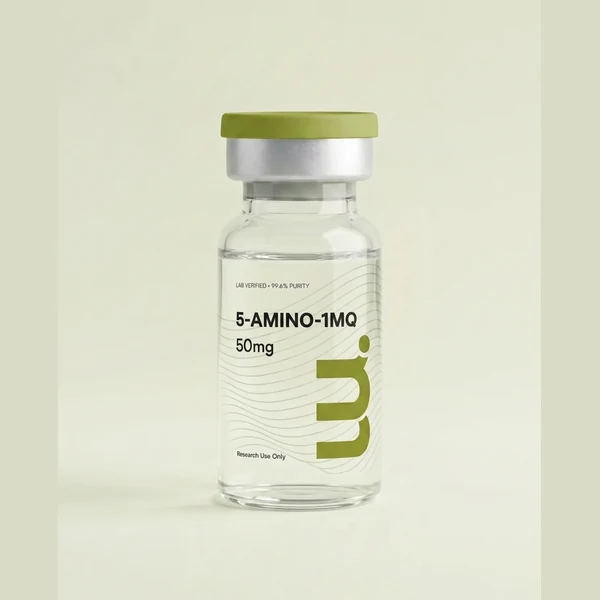
LEAN
5-Amino-1MQ 50mg
5-Amino-1MQ
€119.00
Purity ≥99% · verified by HPLC and mass spectrometry
Order via TelegramIndependent HPLC and mass spectrometry report · 99.94% by HPLC · lot JRZTDB.
Tracked shipping to the United Kingdom, Ireland and the rest of Europe · handling 0–1 days · 14-day right of withdrawal
Technical specification
| CAS number | |
|---|---|
| Sequence | |
| Molecular formula | |
| Molecular weight | |
| Purity | ≥99% |
| Presentation | Lyophilised powder, single-use glass vial |
| Intended use | Laboratory research use only |
5-Amino-1MQ is a small-molecule compound studied as a selective inhibitor of nicotinamide N-methyltransferase (NNMT), an enzyme expressed predominantly in adipose tissue that regulates cellular levels of S-adenosylmethionine and nicotinamide. Unlike the peptides in this catalogue, 5-Amino-1MQ is a small quinolinium-based molecule, and it is studied primarily in the context of adipocyte metabolism research.
The literature on NNMT inhibition examines its role in energy metabolism at the cellular level, with 5-Amino-1MQ used as a pharmacological tool compound in cell culture and rodent studies. Researchers use it to probe how NNMT activity influences methylation capacity and NAD+ salvage pathways within adipocytes.
Research applications
- NNMT enzyme inhibition and adipocyte metabolism research
- Cell-culture studies of methylation capacity and NAD+ salvage
- Rodent models of diet-induced adiposity
- Small-molecule structure-activity research in the quinolinium class
What the literature reports on 5-Amino-1MQ
NNMT catalyses the transfer of a methyl group from S-adenosylmethionine to nicotinamide, a reaction that has been reported to influence both cellular methylation capacity and the availability of nicotinamide for NAD+ salvage synthesis. 5-Amino-1MQ was identified in medicinal chemistry research as a selective, cell-permeable inhibitor of this enzyme.
Adipocyte metabolism research
Because NNMT is highly expressed in white adipose tissue, cell-culture studies using 5-Amino-1MQ have reported changes in adipocyte differentiation markers and lipid accumulation following NNMT inhibition. This research has extended to rodent models of diet-induced adiposity, where studies have reported changes in body composition parameters associated with NNMT inhibition in adipose tissue.
Methylation and NAD+ pathway research
Because NNMT consumes both SAM and nicotinamide, research has examined how its inhibition by 5-Amino-1MQ affects broader cellular methylation reactions and NAD+ salvage pathway flux. This connects 5-Amino-1MQ research to the wider literature on NAD+ metabolism and its role in cellular energy regulation.
Tool-compound research applications
As a selective small-molecule inhibitor, 5-Amino-1MQ is used across multiple laboratories as a pharmacological tool to dissect NNMT-dependent pathways from other metabolic regulators, a role documented in the broader medicinal chemistry literature on quinolinium-based enzyme inhibitors.
Comparative research with peptide-based metabolic compounds
Because 5-Amino-1MQ acts through a distinct, non-peptide mechanism relative to GIP/GLP-1 receptor agonists such as tirzepatide or mitochondrial signalling peptides such as MOTS-c, researchers studying adipose tissue metabolism have used it as a mechanistically independent tool compound, allowing NNMT-pathway effects to be examined separately from incretin-receptor or mitochondrial-signalling pathways within the same experimental systems.
Analytical identity research
Because the compound is registered under several related CAS numbers depending on salt form, analytical chemistry literature has examined the identity and purity characterisation of 5-Amino-1MQ preparations, an area of active documentation given the variation in salt-form labelling observed across commercial suppliers.
Laboratory handling
5-Amino-1MQ is supplied as a powder and should be stored at room temperature or -20°C per the batch certificate of analysis, protected from light and moisture. As a small molecule rather than a peptide, it is generally more stable at room temperature than the peptides in this catalogue, but researchers should follow the storage conditions specified on the batch COA for the specific salt form supplied.
- Powder: store as specified on the batch certificate of analysis, protected from light and moisture.
- Solubility: prepare stock solutions per the researcher's protocol using an appropriate solvent for the salt form supplied.
- Working solutions: prepare fresh where possible; document solvent and concentration for reproducibility.
- Each batch ships with a certificate of analysis confirming ≥99% purity by HPLC and identity by mass spectrometry.
This product is intended for laboratory research use only.
References
- Neelakantan H, Vance V, Wetzel MD, et al. “Selective and membrane-permeable small molecule inhibitors of nicotinamide N-methyltransferase reverse high fat diet-induced obesity in mice”. Biochemical Pharmacology, 2018. PubMed / DOI
- Dimet-Wiley A, Wu Q, Wiley JT, et al. “Reduced calorie diet combined with NNMT inhibition establishes a distinct microbiome in DIO mice”. Scientific Reports, 2022. PubMed / DOI
Related compounds
-
 GLOW
MOTS-c 10mg
Mitochondrial-derived peptide studied in research on metabolic regulation and exercise physiology in animal models.
€79.00
GLOW
MOTS-c 10mg
Mitochondrial-derived peptide studied in research on metabolic regulation and exercise physiology in animal models.
€79.00
-
 LEAN
Tirzepatide 10mg
Dual GIP/GLP-1 receptor agonist peptide studied in metabolic and glucose-regulation research models.
€199.00
LEAN
Tirzepatide 10mg
Dual GIP/GLP-1 receptor agonist peptide studied in metabolic and glucose-regulation research models.
€199.00
-
 GLOW
GHK-Cu 50mg
Copper-binding tripeptide complex studied in research on dermal fibroblast and collagen biology.
€79.00
GLOW
GHK-Cu 50mg
Copper-binding tripeptide complex studied in research on dermal fibroblast and collagen biology.
€79.00