BUILD
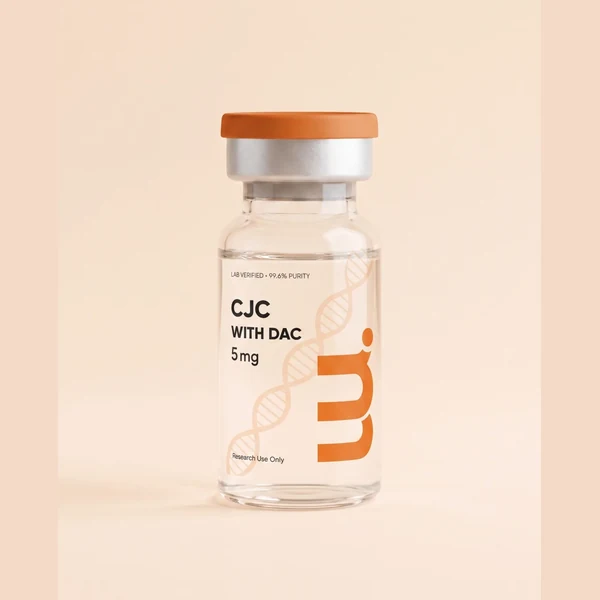
CJC-1295 5mg
CJC-1295
€85.00
Purity ≥99% · verified by HPLC and mass spectrometry
Order via TelegramThe report for the lot that would ship to you is issued on request, before payment.
Tracked shipping to the United Kingdom, Ireland and the rest of Europe · handling 0–1 days · 14-day right of withdrawal
Technical specification
| CAS number | 446262-90-4 |
|---|---|
| Sequence | Tyr-D-Ala-Asp-Ala-Ile-Phe-Thr-Gln-Ser-Tyr-Arg-Lys-Val-Leu-Ala-Gln-Leu-Ser-Ala-Arg-Lys-Leu-Leu-Gln-Asp-Ile-Leu-Ser-Arg-Lys(DAC)-NH2 |
| Molecular formula | C165H269N47O46 |
| Molecular weight | 3647.2 g/mol |
| Purity | ≥99% |
| Presentation | Lyophilised powder, single-use glass vial |
| Intended use | Laboratory research use only |
CJC-1295 is a synthetic analogue of growth-hormone-releasing hormone (GHRH), based on the first 29 residues of native GHRH with amino acid substitutions that confer resistance to enzymatic degradation. This listing corresponds to the long-acting variant carrying a Drug Affinity Complex (DAC) moiety, a maleimidopropionyl group attached to the C-terminal lysine that promotes covalent binding to circulating albumin and extends the molecule's half-life relative to the unmodified 29-residue peptide.
The literature on GHRH analogues, including CJC-1295, examines their activity at the GHRH receptor and downstream effects on growth hormone secretion in animal and human research models. Because the DAC modification specifically targets pharmacokinetics rather than receptor pharmacology, CJC-1295 is frequently studied as a tool for extending GHRH receptor engagement over longer experimental timeframes than achievable with native GHRH.
Research applications
- GHRH receptor binding and activation studies
- Growth hormone secretion research in animal models
- Albumin-binding pharmacokinetic research (DAC technology)
- Comparative research against unmodified GHRH(1-29) analogues
What the literature reports on CJC-1295
CJC-1295 is derived from the first 29 amino acids of native human GHRH, with substitutions at several positions designed to resist degradation by DPP-4 and other peptidases. The DAC-conjugated variant covered here adds a maleimidopropionyl group at the C-terminal lysine, a modification documented in the original medicinal chemistry literature as promoting selective, irreversible binding to a free cysteine residue on serum albumin.
Pharmacokinetic research
The albumin-binding DAC technology used in CJC-1295 has been studied specifically for its effect on circulating half-life, with pharmacokinetic research reporting substantially extended plasma retention compared with unmodified GHRH or the no-DAC variant of CJC-1295. This research has positioned DAC conjugation as a case study in half-life extension strategies for short regulatory peptides.
Growth hormone axis research
Animal studies using CJC-1295 have reported sustained elevation of growth hormone and downstream insulin-like growth factor 1 (IGF-1) levels over extended observation windows, consistent with its prolonged receptor engagement. This research is often discussed alongside studies of pulsatile versus sustained GHRH receptor activation and its differential effects on pituitary somatotroph signalling.
Comparative GHRH-analogue research
Because CJC-1295 without DAC (also studied under the name Modified GRF 1-29) shares the same core 29-residue sequence but lacks the albumin-binding moiety, researchers frequently compare the two variants to isolate pharmacokinetic effects from receptor pharmacology. This comparative approach also extends to combination research with ghrelin-receptor agonists such as Ipamorelin, examined in the CJC-1295 + Ipamorelin blend listing.
Nomenclature research note
Researchers should note that the commercial peptide market has been documented to inconsistently apply the CAS numbers for the DAC and no-DAC variants of CJC-1295, with some vendor listings pairing the no-DAC CAS number with a "with DAC" product description. Cross-referencing the batch certificate of analysis for both molecular weight and sequence is recommended practice when identity confirmation matters to the research protocol.
Laboratory handling
CJC-1295 should be stored as lyophilised powder at -20°C, protected from light and moisture, until reconstitution. Reconstitution follows standard peptide practice, introducing diluent slowly along the vial wall and mixing gently rather than shaking, to preserve the integrity of the DAC-conjugation site.
- Lyophilised powder: store at -20°C, protected from light, until reconstitution.
- Reconstitution: introduce diluent slowly along the vial wall; mix gently, do not shake.
- Post-reconstitution: 2-8°C for short-term laboratory use; avoid repeated freeze-thaw cycles.
- Each batch ships with a certificate of analysis confirming ≥99% purity by HPLC and identity by mass spectrometry.
See the peptide reconstitution and storage guide for a full protocol reference. This product is intended for laboratory research use only.
References
- Teichman SL, Neale A, Lawrence B, Gagnon C, Castaigne JP, Frohman LA. “Prolonged stimulation of growth hormone (GH) and insulin-like growth factor I secretion by CJC-1295, a long-acting analog of GH-releasing hormone, in healthy adults”. Journal of Clinical Endocrinology & Metabolism, 2006. PubMed / DOI
- Alba M, Fintini D, Sagazio A, Lawrence B, Castaigne JP, Frohman LA, Salvatori R. “Once-daily administration of CJC-1295, a long-acting growth hormone-releasing hormone (GHRH) analog, normalizes growth in the GHRH knockout mouse”. American Journal of Physiology - Endocrinology and Metabolism, 2006. PubMed / DOI
Related compounds
-
 BUILD
Ipamorelin 10mg
Selective ghrelin-receptor agonist peptide studied in research on growth hormone secretion pathways.
€79.00
BUILD
Ipamorelin 10mg
Selective ghrelin-receptor agonist peptide studied in research on growth hormone secretion pathways.
€79.00
-
 BUILD
CJC-1295 + Ipamorelin Blend 10mg
Combined GHRH analogue and ghrelin-receptor agonist blend used in growth-hormone-axis research protocols.
€85.00
BUILD
CJC-1295 + Ipamorelin Blend 10mg
Combined GHRH analogue and ghrelin-receptor agonist blend used in growth-hormone-axis research protocols.
€85.00
-
 BUILD
Tesamorelin 10mg
Stabilised GHRH(1-44) analogue studied in research on growth hormone axis regulation in clinical and preclinical models.
€139.00
BUILD
Tesamorelin 10mg
Stabilised GHRH(1-44) analogue studied in research on growth hormone axis regulation in clinical and preclinical models.
€139.00