FOCUS
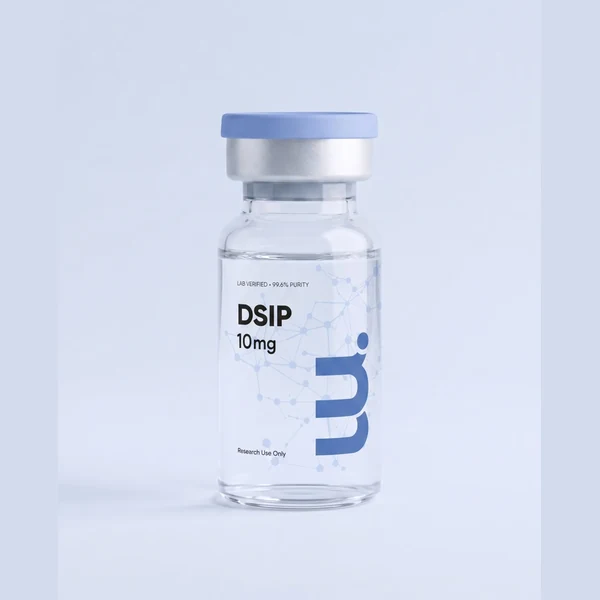
DSIP 10mg
DSIP
€75.00
Purity ≥99% · verified by HPLC and mass spectrometry
Order via TelegramThe report for the lot that would ship to you is issued on request, before payment.
Tracked shipping to the United Kingdom, Ireland and the rest of Europe · handling 0–1 days · 14-day right of withdrawal
Technical specification
| CAS number | 62568-57-4 |
|---|---|
| Sequence | Trp-Ala-Gly-Gly-Asp-Ala-Ser-Gly-Glu |
| Molecular formula | C35H48N10O15 |
| Molecular weight | 848.8 g/mol |
| Purity | ≥99% |
| Presentation | Lyophilised powder, single-use glass vial |
| Intended use | Laboratory research use only |
DSIP (delta sleep-inducing peptide) is a synthetic nonapeptide (Trp-Ala-Gly-Gly-Asp-Ala-Ser-Gly-Glu) first isolated from the cerebral venous blood of rabbits during studies of sleep-related neurochemistry. Its name reflects its original characterisation in research examining slow-wave (delta) sleep states, and it remains a reference compound in sleep neurophysiology research.
The literature on DSIP spans electroencephalographic studies of sleep architecture in animal models, research into hypothalamic-pituitary-adrenal axis modulation, and broader neurochemistry research examining stress-response signalling. Its precise receptor mechanism remains an active area of investigation, distinguishing DSIP research from peptides with well-characterised single-receptor pharmacology.
Research applications
- EEG-based sleep architecture research in animal models
- Hypothalamic-pituitary-adrenal axis signalling studies
- Stress-response neurochemistry research
- Comparative neuropeptide receptor-mechanism research
What the literature reports on DSIP
DSIP was first isolated and characterised in the 1970s from studies of rabbit cerebral venous blood collected during induced slow-wave sleep, with the peptide named for its association with this sleep state in the original research. Its nine-residue sequence has since been synthesised and studied across multiple independent laboratories.
Sleep architecture research
Electroencephalographic studies in animal models have reported changes in sleep-stage distribution, including measures of slow-wave sleep duration, following DSIP administration, although findings across the literature have been described as variable depending on dose, timing and species studied. This variability is itself a subject of ongoing neurochemistry research.
HPA axis research
A separate line of DSIP research has examined its effects on the hypothalamic-pituitary-adrenal axis, with studies reporting modulation of corticotropin-releasing hormone and cortisol/corticosterone signalling in animal models. This research has positioned DSIP within the broader literature on peptides influencing stress-response neuroendocrinology.
Receptor mechanism research
Unlike many peptides with a clearly identified single receptor target, DSIP's precise mechanism of action remains incompletely characterised in the published literature, and research continues to investigate candidate binding sites and downstream signalling pathways. This makes DSIP a subject of ongoing mechanistic neuropeptide research rather than a compound with settled receptor pharmacology.
Comparative neuropeptide research
DSIP is occasionally studied alongside other short regulatory neuropeptides in this catalogue, such as Selank, in comparative research examining structurally distinct peptides that each influence central nervous system activity through incompletely resolved or multi-target mechanisms, an approach used to contrast well-characterised receptor pharmacology against more exploratory neuropeptide research.
Circadian rhythm research
Because DSIP was originally isolated in the context of sleep-stage-specific blood sampling, subsequent research has examined its relationship to circadian rhythm markers more broadly, including studies of diurnal variation in endogenous peptide levels, extending DSIP research into the wider chronobiology literature.
Laboratory handling
DSIP should be stored as lyophilised powder at -20°C, protected from light and moisture, until reconstitution. Reconstitution follows standard peptide practice: diluent introduced slowly along the vial wall, followed by gentle mixing.
- Lyophilised powder: store at -20°C, protected from light, until reconstitution.
- Reconstitution: introduce diluent slowly along the vial wall; mix gently, do not shake.
- Post-reconstitution: 2-8°C for short-term laboratory use; avoid repeated freeze-thaw cycles.
- Each batch ships with a certificate of analysis confirming ≥99% purity by HPLC and identity by mass spectrometry.
See the peptide reconstitution and storage guide for a full protocol reference. This product is intended for laboratory research use only.
References
- Schneider-Helmert D, Gnirss F, Monnier M, Schenker J, Schoenenberger GA. “Acute and delayed effects of DSIP (delta sleep-inducing peptide) on human sleep behavior”. International Journal of Clinical Pharmacology, Therapy, and Toxicology, 1981. PubMed
- Bes F, Hofman W, Schuur J, Van Boxtel C. “Effects of delta sleep-inducing peptide on sleep of chronic insomniac patients. A double-blind study”. Neuropsychobiology, 1992. PubMed / DOI
- Monti JM, Debellis J, Alterwain P, Pellejero T, Monti D. “Study of delta sleep-inducing peptide efficacy in improving sleep on short-term administration to chronic insomniacs”. International Journal of Clinical Pharmacology Research, 1987. PubMed
- Kovalzon VM, Strekalova TV. “Delta sleep-inducing peptide (DSIP): a still unresolved riddle”. Journal of Neurochemistry, 2006. PubMed / DOI
Related compounds
-
 FOCUS
Selank 10mg
Synthetic tuftsin analogue investigated in animal studies of anxiety-related behaviour and immune modulation.
€85.00
FOCUS
Selank 10mg
Synthetic tuftsin analogue investigated in animal studies of anxiety-related behaviour and immune modulation.
€85.00
-
 FOCUS
Semax 10mg
Synthetic ACTH(4-10) fragment analogue studied in preclinical models of memory, attention and neuroprotection.
€85.00
FOCUS
Semax 10mg
Synthetic ACTH(4-10) fragment analogue studied in preclinical models of memory, attention and neuroprotection.
€85.00
-
 RECOVER
Thymosin Alpha-1 10mg
Immunomodulatory peptide studied in preclinical research on immune cell signalling and response.
€85.00
RECOVER
Thymosin Alpha-1 10mg
Immunomodulatory peptide studied in preclinical research on immune cell signalling and response.
€85.00