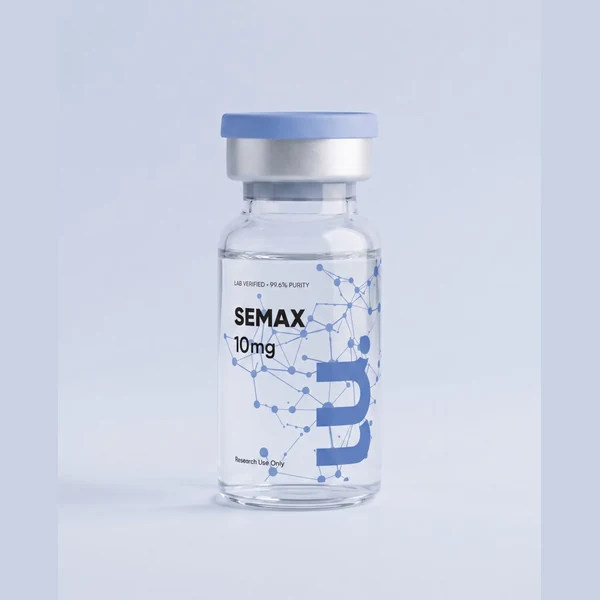
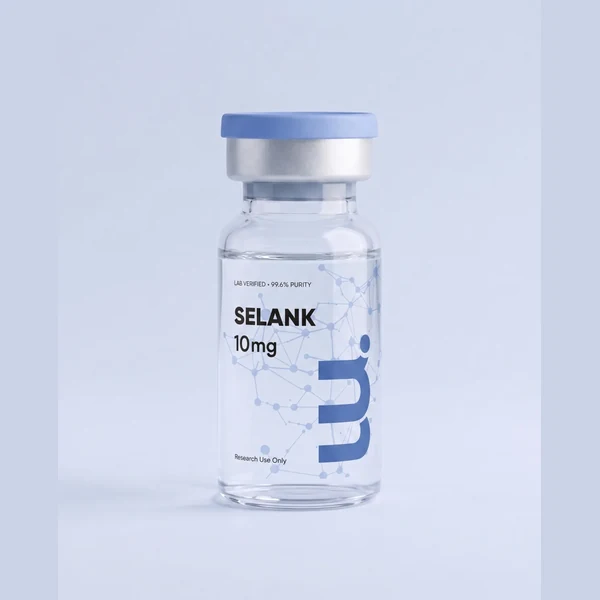
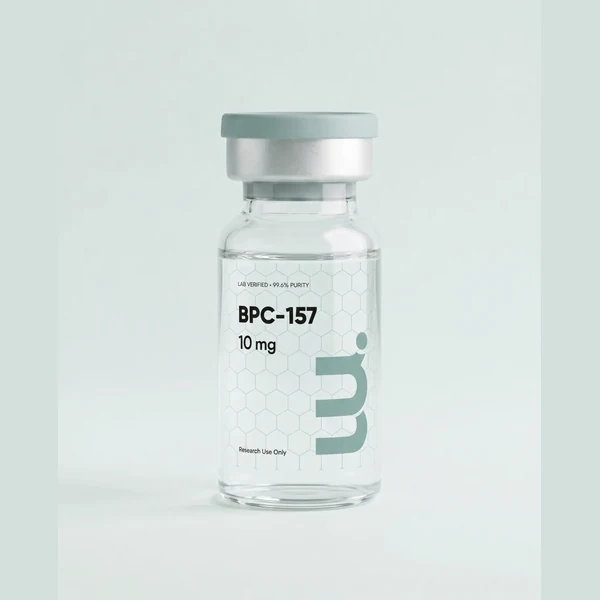
Every peptide in SemaxBuy's catalogue, including Semax and Selank, is supplied lyophilised: freeze-dried into a stable powder for shipping and long-term storage. Once reconstituted into solution, a peptide's behaviour changes substantially, and the published pharmacokinetic literature on peptides such as Semax gives a useful illustration of why handling practice matters as much as sourcing. This guide sets out general laboratory practice for reconstitution and storage; it is not a substitute for a specific protocol or institutional standard operating procedure. You can run the arithmetic below through our reconstitution calculator.
Why lyophilised form is more stable
Peptide degradation in solution proceeds through several well-characterised chemical pathways: oxidation of susceptible residues such as methionine, deamidation of asparagine and glutamine side chains, hydrolysis of the peptide backbone, and non-covalent aggregation. Removing water from the system, as lyophilisation does, sharply slows most of these pathways, which is why lyophilised peptide stored correctly and sealed against moisture remains close to its labelled purity for far longer than the same peptide once dissolved. The practical consequence is straightforward: a laboratory should reconstitute only the quantity of material needed for near-term use, and should keep the remaining lyophilised stock sealed and appropriately stored rather than reconstituting a full vial in advance.
What happens once a peptide is in solution
Pharmacokinetic work on Semax illustrates how quickly a peptide in a biological or aqueous environment can be altered. In a rat study using radiolabelled Semax dosed intranasally, researchers detected the peptide in brain tissue within two minutes, but found that it underwent rapid enzymatic breakdown, with the tripeptide fragment Pro-Gly-Pro recovered as the predominant species in biological samples shortly after administration (Shevchenko et al., 2006, Russian Journal of Bioorganic Chemistry). A separate in vitro study using rat blood enzymes identified aminopeptidase-mediated cleavage of the N-terminal residues as a principal route of degradation for both ACTH(4-10) and Semax in serum (Potaman et al., 1991, Biochemical and Biophysical Research Communications). Neither study is about shelf-stability of a research reagent in a freezer — they describe enzymatic environments, not bench storage — but together they illustrate that these peptide backbones are chemically reactive once in solution, which is the same underlying property that makes reconstituted-peptide storage time-limited on the laboratory bench.
Reconstitution practice
Standard laboratory practice for reconstituting a lyophilised peptide involves bringing the vial to room temperature before opening, adding diluent slowly down the interior wall of the vial rather than directly onto the powder, and allowing the material to dissolve without vigorous shaking, which can denature or aggregate peptide chains at the air-liquid interface. Bacteriostatic water (water containing a small proportion of benzyl alcohol as a preservative) is commonly used in research settings because it inhibits bacterial growth across repeated withdrawals from the same vial; sterile water without a preservative has a shorter usable window once opened. Researchers should follow their institution's own protocol for diluent choice and concentration, and record the reconstitution date and diluent on the vial label for traceability.
Concentration calculations should be checked twice before diluent is added, since a reconstitution error is not straightforward to correct after the fact without discarding the vial. Once a target concentration is chosen, the diluent volume required follows directly from the labelled peptide mass on the certificate of analysis; researchers should use that batch-specific figure rather than an assumed round number, since actual peptide content can vary slightly between batches even at nominally identical purity.
Labelling, aliquoting and record-keeping
Every reconstituted vial and every aliquot taken from it should be labelled with, at minimum, the peptide identity, batch or lot number, reconstitution date, diluent used and resulting concentration. This is not a bureaucratic formality: in a laboratory handling several research peptides in parallel, unlabelled or ambiguously labelled vials are a recognised source of experimental error, and a labelling error involving a peptide is harder to catch visually than one involving a solid reagent with a distinct appearance, since most reconstituted peptide solutions are visually indistinguishable from one another. Keeping a simple log — batch number, date opened, date reconstituted, number of aliquots taken — alongside the physical labelling gives a laboratory a way to trace a specific experimental result back to a specific vial if a question arises later, which matters when results are being prepared for publication and need to be reproducible from recorded conditions.
Storage temperature and freeze-thaw cycling
Lyophilised peptide is generally stored frozen, protected from light and moisture, for longest-term stability, with refrigerated storage acceptable for shorter intervals; the exact recommended conditions vary by peptide and should be taken from the specific product's certificate of analysis and handling notes rather than assumed to be uniform across all compounds. Once reconstituted, solution should be kept refrigerated and used within a comparatively short window, and should not be left at room temperature for extended periods. Repeated freeze-thaw cycling of a reconstituted solution is a recognised source of aggregation and peptide-bond hydrolysis in the broader peptide-chemistry literature, and is best avoided by dividing a reconstituted vial into single-use aliquots at the point of first thaw rather than refreezing and rethawing the same working stock. For notes on how these handling considerations interact with the specific stability profile of Semax and Selank, see the Semax research overview; for guidance on evaluating a supplier before material reaches the laboratory at all, see How to source research-grade Semax in Europe. All peptides discussed here are supplied by SemaxBuy for research use only, not for human or veterinary administration.
Working with several peptides in parallel
Laboratories running comparative protocols across several of SemaxBuy's catalogue — for example, Semax alongside Selank, or a regulatory peptide alongside a structurally unrelated compound such as BPC-157 — should treat each peptide's storage and reconstitution requirements independently rather than assuming a single protocol suits all of them. Peptides differ in solubility, in the number and type of residues susceptible to oxidation, and in reported stability once reconstituted; a diluent, concentration or storage temperature validated for one compound should not be assumed to transfer to another without checking that peptide's own certificate of analysis and handling notes. Colour-coded labelling or physically separated storage locations by peptide are simple, low-cost ways to reduce the risk of cross-contamination or mix-ups when several reconstituted vials are in active use at once.
Handling practice ties back to sourcing
Good reconstitution and storage practice cannot correct for material that was already degraded, mislabelled or contaminated before it reached the laboratory. The certificate of analysis that accompanies a batch is the reference point against which handling should be judged: if a peptide fails to dissolve as expected, if a solution develops visible cloudiness or precipitate shortly after reconstitution, or if experimental results diverge unexpectedly from a well-established literature finding, the certificate of analysis and the supplier's documented handling and shipping practice are the first things worth reviewing, before assuming an error in reconstitution technique. This is why the sourcing guidance in How to source research-grade Semax in Europe and the handling practice described here are best read as a single continuous chain of quality control, from synthesis through shipping to the point a peptide is finally used, rather than as two unrelated topics.
Taken together, the practices set out in this guide — minimal reconstitution ahead of need, careful diluent handling, consistent labelling, appropriate storage temperature and avoidance of unnecessary freeze-thaw cycling — are ordinary peptide-chemistry discipline rather than anything specific to Semax or Selank. Applying them consistently is what allows a laboratory's own results to be attributed, with confidence, to the biology under study rather than to variability introduced after the material left the supplier.