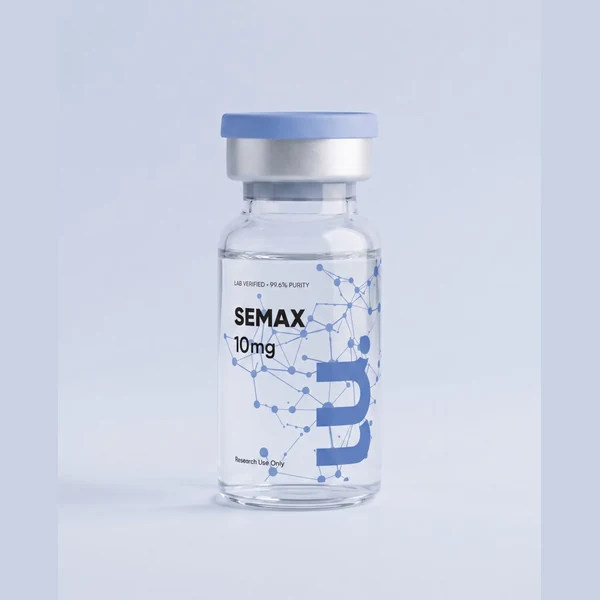
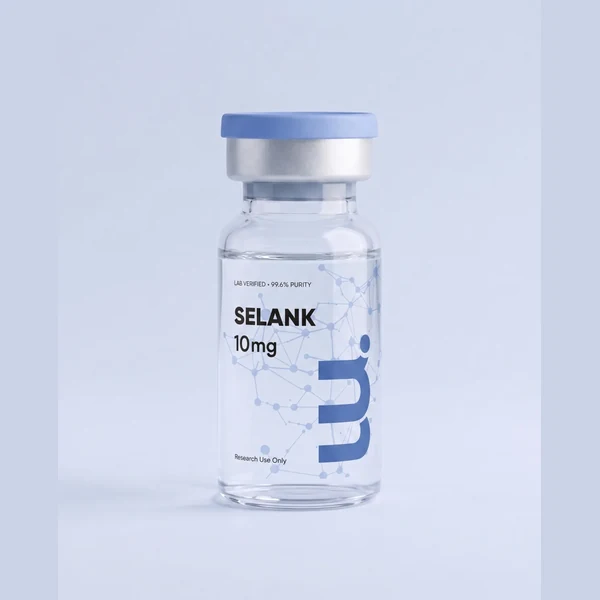
Semax is a synthetic heptapeptide derived from a fragment of adrenocorticotropic hormone (ACTH). It was developed in Russia in the 1980s by a research group at the Institute of Molecular Genetics led by Ivan Ashmarin and Nikolay Myasoedov, who set out to isolate the central nervous system activity of ACTH from its hormonal, corticotropic action. The resulting molecule retains the four-amino-acid core of ACTH(4-10) responsible for its central effects while adding a short C-terminal extension that resists rapid enzymatic breakdown. Semax has since become one of the most extensively studied peptides to come out of the Russian regulatory-peptide research tradition, with a published record spanning molecular pharmacology, rodent behavioural models and, in Russia, clinical research in neurology. This page summarises what that literature reports. It is written for laboratory buyers and researchers; it is not medical information, and Semax as sold by SemaxBuy is supplied for research use only, not for human or veterinary administration.
This overview is deliberately narrow in scope: it reports what named, citable studies say about a single molecule, rather than summarising the wider secondary literature that circulates about Semax across blogs, forums and supplier marketing pages. Every specific finding described below is attributed to a paper, with a link to that paper's PubMed or DOI record in the numbered reference list at the end of the page, so a reader can verify a claim against its source rather than take a paraphrase on trust. Readers who want the underlying chemistry, laboratory handling and sourcing detail broken out separately can follow the links into the four companion guides referenced throughout this page and listed again at the end, covering Semax's relationship to Selank, the N-Acetyl Semax Amidate analogue, reconstitution and storage practice, and supplier verification.
Structure and chemical properties
Semax corresponds to the sequence Met-Glu-His-Phe-Pro-Gly-Pro, sold under the CAS number 80714-61-0. It comprises the ACTH(4-7) core (Met-Glu-His-Phe) — the fragment reported to carry ACTH's central activity without its corticotropic effect on the adrenal cortex — fused to the tripeptide Pro-Gly-Pro. That C-terminal tripeptide occurs naturally as a degradation product of several regulatory peptides and appears to slow proteolytic cleavage of the parent sequence, extending its functional half-life relative to unmodified ACTH(4-10). The molecular formula is C37H51N9O10S, with a molecular weight of approximately 813 g/mol. As supplied, Semax is a lyophilised (freeze-dried) white powder, verified for identity and purity by high-performance liquid chromatography (HPLC) and mass spectrometry, with a certificate of analysis issued per batch (see COA & purity).
In its lyophilised form Semax is generally described in the peptide-manufacturing literature as reasonably stable when sealed against moisture and light, consistent with most short synthetic peptides of comparable size. It is soluble in water and in bacteriostatic saline, which is the basis for the intranasal and injectable routes used across the published animal literature summarised below. As with any short peptide containing a methionine residue, the molecule is susceptible to oxidation once in solution, which is one reason analytical verification (HPLC purity plus mass-spectrometry identity confirmation) is checked at the point of manufacture rather than assumed to hold indefinitely after a vial has been opened; handling practice that keeps this stability profile intact is covered in Peptide reconstitution and storage in the laboratory.
What the research literature reports
The published record on Semax clusters around three areas: neurotrophin signalling, monoaminergic neurotransmission, and models of cerebral ischaemia.
BDNF and TrkB signalling
Dolotov and colleagues reported that intranasal Semax administration in rats increased both brain-derived neurotrophic factor (BDNF) protein and mRNA levels, and enhanced phosphorylation of the BDNF receptor TrkB, in the hippocampus (Dolotov et al., 2006, Brain Research). A related study from the same group, using radiolabelled binding assays in rat basal forebrain membranes, described specific and reversible Semax binding associated with a rapid rise in BDNF protein (Dolotov et al., 2006, Journal of Neurochemistry). These two papers form the core mechanistic basis cited in most subsequent Semax research and are the most frequently referenced findings in the compound's literature.
Monoaminergic systems
Eremin and colleagues reported that Semax administration in rodents raised striatal serotonin turnover and potentiated amphetamine-evoked extracellular dopamine release, describing Semax as an activator of dopaminergic and serotoninergic brain systems in that model (Eremin et al., 2005, Neurochemical Research). This body of work is frequently cited alongside the BDNF findings as a candidate explanation for Semax's reported behavioural effects in rodent learning and memory paradigms.
Cerebral ischaemia models
A pilot study in a rat model of experimental focal cerebral ischaemia reported changes in brain-cell morphology and proliferative activity following administration of Semax and its C-terminal fragment Pro-Gly-Pro (Stavchansky et al., 2011, Journal of Molecular Neuroscience). In parallel, a non-randomised Russian clinical study of 110 patients following ischaemic stroke examined intranasal Semax courses and reported changes in Barthel index and motor-scale scores over approximately five months of follow-up (Gusev et al., 2018, Zhurnal Nevrologii i Psikhiatrii). This clinical literature is Russian in origin, was not placebo-controlled in the 2018 study design, and should be read as a description of a national clinical-research tradition rather than as a basis for any claim about outcomes in other regulatory settings.
Reading the literature critically
A researcher approaching the Semax literature for the first time should note several features common to this body of work. Much of it, including the foundational degradation and kinetics studies, originates from a small number of overlapping Russian research groups working over several decades, which means the literature is not as independently replicated across separate laboratories as would be expected for a compound with a comparably long publication history in an internationally distributed field. Sample sizes in the rodent studies are typically modest, and the one large-scale human study summarised above was neither randomised nor placebo-controlled by contemporary trial-design standards. None of this invalidates the findings, but it does mean that mechanistic claims about Semax should be traced to their specific source paper and read with that context in mind, rather than treated as settled pharmacology. This is the reasoning behind the citation-linked format used throughout this page.
Semax vs NA-Semax-Amidate
Two closely related sequences circulate in the research-peptide market: Semax itself, and a modified analogue usually labelled N-Acetyl Semax Amidate, in which the N-terminus carries an acetyl group and the C-terminus is amidated rather than a free acid. Because the original degradation studies on Semax identified aminopeptidase-mediated cleavage of the N-terminal Met-Glu residues as a principal breakdown route in rat serum (Potaman et al., 1991, Biochemical and Biophysical Research Communications), blocking that N-terminal site is the chemical rationale usually given for the acetylated analogue's greater in vitro stability. The two sequences are not interchangeable in a literature sense: the BDNF, monoaminergic and ischaemia studies summarised above were conducted with unmodified Semax, not with the acetylated variant, which has a comparatively small independent published record. Researchers who need to map a specific finding to a specific molecule should treat the two as distinct research subjects. A structural and sourcing comparison is set out in the guide on N-Acetyl Semax Amidate. In practice, the two names are sometimes used loosely by suppliers and secondary sources as though they were interchangeable labels for the same product, which is a source of confusion for buyers trying to map a listing back to a specific published study. Anyone citing Semax research in support of a protocol should confirm which of the two sequences the cited paper actually used before ordering either one.
Semax and Selank: the Russian regulatory-peptide family
Semax was developed alongside a second heptapeptide, Selank (Thr-Lys-Pro-Arg-Pro-Gly-Pro), built on the same Pro-Gly-Pro-stabilised design principle but derived from tuftsin rather than ACTH. Where the Semax literature centres on BDNF signalling and monoaminergic activity, Selank's published record centres on anxiolytic-type behavioural endpoints: a Russian comparative clinical study reported anxiolytic effects in patients with generalised anxiety disorder comparable to a reference benzodiazepine (Zozulia et al., 2008), a rodent study reported that combining Selank with diazepam reduced anxiety-related behaviour more than either compound alone under chronic mild stress (Kasian et al., 2017, Behavioural Neurology), and intranasal Selank has been reported to alter hippocampal BDNF expression in rats in a manner broadly parallel to Semax (Inozemtseva et al., 2008, Doklady Biological Sciences). The two peptides are frequently studied together in the Russian literature as a pair, and are sold together in SemaxBuy's catalogue as Semax 10mg and Selank 10mg. A detailed side-by-side comparison is available in Semax vs Selank.
Semax and Selank sit within a broader category that Russian pharmacology literature has described as "regulatory peptides": short sequences derived from larger endogenous signalling molecules, stabilised with a glyproline (proline-glycine-proline-type) motif, and studied primarily for central-nervous-system and behavioural endpoints in animal models rather than as replacements for the parent hormone's systemic activity. Other members of that broader research family exist in the literature beyond Semax and Selank, but the two peptides carried in SemaxBuy's catalogue are, by a wide margin, the most extensively studied and most frequently cited pair from that tradition.
Laboratory handling
Semax is supplied lyophilised and is reported in the pharmacokinetic literature to undergo rapid enzymatic breakdown once in solution or in circulation: a rat intranasal study using radiolabelled Semax detected the peptide in brain tissue within two minutes of dosing, with the tripeptide Pro-Gly-Pro identified as the predominant metabolite recovered in biological samples shortly afterwards (Shevchenko et al., 2006, Russian Journal of Bioorganic Chemistry). That rapid degradation kinetics profile is consistent with standard peptide chemistry practice: lyophilised material is generally more stable across long-term storage than reconstituted solution, and reconstituted peptide should be kept refrigerated and used within a short window once bacteriostatic or sterile water has been added. Repeated freeze-thaw cycling of reconstituted material is a recognised source of peptide-bond hydrolysis and aggregation in the wider peptide-chemistry literature and is best avoided by aliquoting before freezing. A full protocol-level discussion is in Peptide reconstitution and storage in the laboratory.
These stability considerations also inform how Semax should move between supplier and laboratory. SemaxBuy ships lyophilised material in sealed packaging with tracked delivery across the European Union, with orders typically leaving within zero to one working day and transit taking two to five working days depending on destination; keeping the peptide in its lyophilised state for as much of that journey as possible is precisely what limits degradation before it ever reaches a laboratory freezer. Buyers should inspect packaging on arrival and store material immediately according to the certificate of analysis rather than leaving a delivered parcel at ambient temperature for an extended period.
Quality and verification
Because Semax degrades readily once out of lyophilised form, and because the research- peptide market includes suppliers of variable quality, a certificate of analysis (COA) is the primary means by which a laboratory can confirm that a given batch matches its labelled identity and purity. A COA for a Semax batch should report reversed-phase HPLC purity (SemaxBuy lists ≥99% by HPLC across its catalogue), a mass-spectrometry identity check confirming the expected molecular weight, and batch-specific traceability rather than a generic specification sheet reused across lots. Buyers comparing suppliers should treat the absence of a batch-specific COA, or a COA that cannot be matched to the vial in hand, as a red flag. This is discussed at length, with a checklist, in How to source research-grade Semax in Europe.
Purity documentation is not only a commercial reassurance; it is a precondition for relating a laboratory's own results back to the published literature at all. The BDNF, monoaminergic and ischaemia-model findings summarised above were generated with material characterised to a known standard, and an experiment intended to build on or test those findings needs a comparable degree of confidence in what is actually in the vial. A COA that cannot be tied to the specific batch received, or that omits either the HPLC or the mass-spectrometry component of identity verification, leaves that link unconfirmed.
Regulatory framework in the EU
Semax has no marketing authorisation as a medicine in the European Union or the United Kingdom and is not included in any EU pharmacopoeia. It is sold across the region, including by SemaxBuy, exclusively as a research chemical: a reagent intended for laboratory research use only, not for administration to humans or animals, and not for diagnostic use. This status places Semax in the same regulatory category as most other synthetic research peptides referenced on this site — a category defined by the absence of an authorised medicinal use, not by any judgment on the underlying science. Researchers purchasing Semax within the EU are responsible for confirming that their institution's handling, storage and use of the material comply with applicable local research-chemical, laboratory-safety and import regulations. Every product and content page on this site carries the same disclaimer stated in full below.
SemaxBuy's own compliance position follows directly from this status. The site does not present Semax as a medicine, a dietary aid or a consumer wellness product; it does not offer dosing advice for human administration; and it does not publish product reviews or ratings, a policy adopted specifically because unverified testimonials in a health-adjacent category carry regulatory and credibility risk without adding anything to the scientific record. What the site does provide is batch-specific analytical documentation and a literature summary that links directly to primary sources, on the view that this is the information a genuine research buyer actually needs.
For laboratory research use only. Not for human or veterinary consumption. Not a medicine and not intended to diagnose, treat, cure or prevent any disease.
Further reading
Four companion guides expand on specific aspects of this overview in more depth. Semax vs Selank sets out a structural and literature-based comparison of the two peptides developed by the same research programme. N-Acetyl Semax Amidate explains the N-terminal and C-terminal modifications found in that market analogue and why its literature is not interchangeable with unmodified Semax's. Peptide reconstitution and storage in the laboratory covers diluent choice, temperature and freeze-thaw practice in more detail than fits here. How to source research-grade Semax in Europe gives a practical checklist for evaluating a supplier's certificate of analysis before ordering.