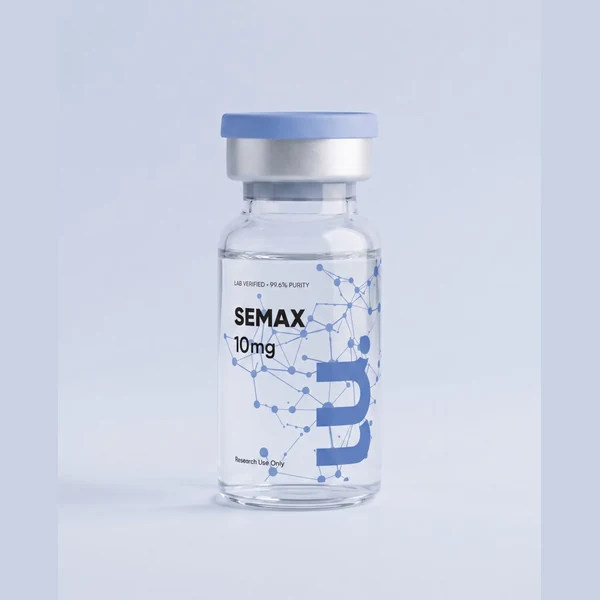
Semax and Noopept are frequently searched together but are structurally unrelated compounds studied through different reported mechanisms: Semax is a heptapeptide linked primarily to neurotrophin gene expression, while Noopept is a small prodrug molecule metabolised to cycloprolylglycine, a compound studied for hypoxia-inducible factor 1 (HIF-1) activation and AMPA/TrkB-receptor-dependent signalling. Grouping them under the informal "nootropic peptide" label obscures that difference, which matters for anyone designing a comparative protocol. Background on Semax specifically is covered on the pillar page for the compound.
What is Noopept, structurally, and how does it differ from Semax?
Noopept is the ethyl ester of N-phenylacetyl-L-prolylglycine, a synthetic dipeptide-derived molecule developed by Tatiana Gudasheva and colleagues. In rats, esterases hydrolyse the ethyl ester to N-phenylacetyl-L-prolylglycine, which is reported to cyclise further to cycloprolylglycine, releasing phenylacetic acid in the process — meaning the parent molecule functions largely as a prodrug for a smaller active metabolite. Semax, by contrast, is a seven-residue peptide, Met-Glu-His-Phe-Pro-Gly-Pro, that is reported to act directly rather than through a smaller circulating metabolite. The two compounds share no structural lineage: Noopept derives from a dipeptide chemistry programme distinct from the ACTH(4-10) fragment work that produced Semax, a history covered in ACTH(4-10) fragment peptides.
What does the literature report about Noopept's mechanism?
Research led by Gudasheva and Tatiana Ostrovskaya reports that Noopept's active metabolite, cycloprolylglycine, increases the DNA-binding activity of the transcription factor HIF-1 by binding to prolyl hydroxylase 2, a mechanism distinct from most other pathways studied in cognition-focused peptide research. A separate line of work from the same research group reports that Noopept's effects in animal models depend on AMPA- and TrkB-receptor activation, and that its neurotrophin-related outcomes include changes in NGF and BDNF expression — a molecular endpoint that overlaps with, but is reached through a different route than, the BDNF/TrkB signalling most associated with Semax.
What does the Semax literature report by comparison?
The Semax literature centres on direct gene-transcription effects rather than a prodrug mechanism: a rat hippocampus study reports that Semax administration increased BDNF protein and mRNA levels alongside enhanced TrkB receptor phosphorylation. A separate study reports that Semax activates dopaminergic and serotoninergic systems in rodents, raising striatal serotonin turnover and potentiating amphetamine-evoked dopamine release — a neurotransmitter-level effect that has no direct counterpart in the published Noopept mechanism papers. A fuller summary of this evidence base is set out in Semax research overview.
Do the two compounds converge on any shared endpoint?
Despite the different upstream mechanisms, a 2021 study in the Neurochemical Journal examined subchronic administration of both Noopept and Semax in BALB/c mice and reported that both compounds were associated with increased density of cortical GABA-A receptors — a downstream convergence point even though the pathways that lead there differ. This is a useful illustration of why comparing compounds purely by informal category can mislead: two structurally unrelated molecules can still be reported to converge on a shared receptor system, while two structurally related molecules, such as Selank and Semax, can diverge in their primary reported target despite sharing the same PGP-stabilised heptapeptide backbone, a comparison detailed in Semax vs Selank.
How does analytical verification differ between the two compounds?
Semax is a single defined seven-residue sequence, which makes HPLC and mass spectrometry verification straightforward: a COA can report one expected molecular weight and one expected retention time. Noopept's active form in circulation is its cyclised metabolite rather than the parent ester, which means a rigorous analytical characterisation of Noopept research material should specify which species — parent ester or metabolite — a given purity figure refers to. This distinction is a direct extension of the broader point covered in what HPLC purity actually measures: a purity percentage is only meaningful once it is clear which molecule is being measured.
| Compound | Structure | Reported primary mechanism |
|---|---|---|
| Semax | Heptapeptide, ACTH(4-7)+PGP | BDNF/TrkB gene expression; dopaminergic/serotoninergic activation |
| Noopept | Dipeptide-derived prodrug ester | HIF-1 activation via cycloprolylglycine; AMPA/TrkB-dependent signalling |
What should a researcher take from this comparison?
A study comparing Semax against Noopept is, at the molecular level, comparing a gene-transcription-linked heptapeptide against a prodrug metabolite acting through prolyl hydroxylase and HIF-1 signalling — a legitimate comparison, but one that should be framed around the specific endpoint under study rather than the informal "nootropic" label both compounds are marketed under. A broader survey of how Semax compares against this wider category, including Selank and Cerebrolysin, is available in Semax vs other nootropic-class peptides.
What about clinical-context research for each compound?
Semax carries a Russian pharmaceutical registration and an associated body of clinical-context literature, including a non-randomised study of participants recovering from ischaemic stroke that reported changes in functional recovery scores over a period of intranasal courses. Noopept similarly carries Russian clinical use in cognition-focused contexts, with a distinct clinical literature built around its own mechanism. Neither compound's Russian clinical status extends to EU or UK regulatory recognition, and both are supplied on this site strictly as research reagents rather than as approved medicines in the EU, a distinction covered generally in buying research peptides in Europe.
What does this mean for a comparative study design?
A researcher designing a head-to-head protocol comparing Semax and Noopept should decide, before starting, which specific endpoint the study is testing — BDNF/TrkB expression, HIF-1 pathway activity, GABA-A receptor density, or a behavioural task — since the two compounds are not interchangeable substitutes for one another at the mechanistic level despite their shared informal category. Dose and route also need to be held to what each compound's own literature has characterised, rather than assumed to transfer from one peptide's established protocol to the other, an issue that also applies to route-of-administration choices covered in why intranasal administration appears in the Semax literature.
How should a researcher verify Noopept research material specifically?
Because Noopept functions largely as a prodrug for its cyclised metabolite, a certificate of analysis for Noopept research material should specify unambiguously which species — the parent ethyl ester or the cyclised metabolite — the stated purity and molecular weight refer to, since the two have different masses and different expected retention times on an HPLC trace. A COA that reports only a bare purity percentage without identifying which molecular species was measured leaves the same ambiguity that a well-documented Semax or Selank COA avoids by reporting a single, unambiguous sequence and molecular weight, a distinction covered generally in how to read a peptide COA.
Why is this distinction useful beyond a single comparative study?
Treating “nootropic peptide” as a single mechanistic category has a cost beyond any one experiment: it makes literature searches less precise, since a search for nootropic peptide mechanisms returns findings spanning HIF-1 activation, GABA-A modulation and direct neurotrophin gene transcription as though they were describing one pathway. Filtering by compound name and specific endpoint, rather than by category label, produces a more usable literature review and avoids conflating findings that are not actually comparable, a discipline that applies as much to Semax as to any other compound covered on this site.
As with all material on this site, the above is a summary of published animal and in-vitro research and is intended for research use only. Semax and the rest of the verified peptide range are available in the catalogue with batch-specific documentation.