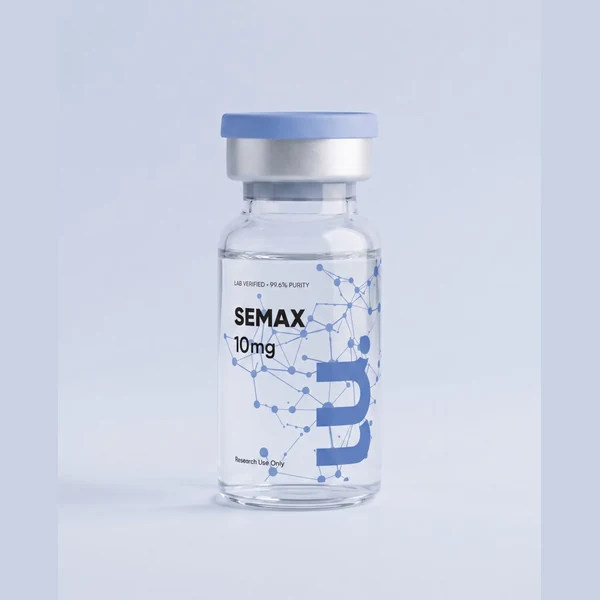
Intranasal administration appears throughout the Semax research literature because the nasal cavity offers a documented route past the blood-brain barrier, via the olfactory and trigeminal nerve pathways, that a peptide the size of Semax cannot easily cross by other means. This is a methodological feature of how the studies were designed, not guidance for any reader — every figure discussed below describes what a specific rodent or clinical study protocol used, not an instruction. Background on the compound itself is covered on the Semax research pillar page.
Why does the blood-brain barrier matter for a peptide the size of Semax?
The blood-brain barrier restricts the movement of most large, hydrophilic molecules from the bloodstream into brain tissue, a restriction that applies to peptides more than to small, lipophilic molecules generally. A heptapeptide such as Semax, with a molecular weight of 813.9 g/mol, does not cross this barrier efficiently through passive diffusion, which is one reason researchers studying central-nervous-system peptides have looked for administration routes that reduce reliance on crossing the barrier directly rather than routes that depend on it.
How does intranasal administration relate to the olfactory and trigeminal pathways?
The nasal cavity is unusual anatomically because the olfactory and trigeminal nerves provide a direct connective route between the external environment and the central nervous system. Material deposited in the upper posterior nasal cavity can be absorbed by the olfactory epithelium and transported along olfactory nerve fibres, or absorbed by the trigeminal nerve, in both cases reaching brain tissue while largely bypassing the blood-brain barrier rather than crossing it. This nose-to-brain route is documented broadly in the pharmacology literature on peptide and protein delivery to the central nervous system, not specifically for Semax alone, and it is the general mechanism that Semax studies rely on when using the intranasal route.
What does the Semax-specific pharmacokinetic literature report?
A study tracking radiolabelled Semax after intranasal administration in rats reported detectable levels of the compound in brain tissue within two minutes of dosing, with rapid enzymatic breakdown yielding the Pro-Gly-Pro tripeptide as the predominant metabolite recovered in biological samples. That speed of appearance in brain tissue is the kind of pharmacokinetic evidence that supports intranasal administration as a route capable of reaching the central nervous system quickly in a rodent model, distinct from the separate question of what gene-expression or behavioural effect is subsequently reported. The gene-expression side of that picture — increased BDNF protein and mRNA following intranasal dosing in rat hippocampus — is covered in the Semax research overview.
Why is the intranasal route also used in the Russian clinical literature?
Russian clinical research on Semax, conducted under that country's own pharmaceutical framework, has also used the intranasal route across a range of study protocols, including a non-randomised study of 110 study participants following ischaemic stroke, which used courses of intranasal administration over defined multi-day periods as part of post-stroke recovery research. That clinical usage follows the same underlying pharmacological reasoning as the rodent pharmacokinetic work: the nasal route offers a way to reach the central nervous system without relying on the compound crossing the blood-brain barrier via systemic circulation. None of these study figures describe guidance for use outside a supervised research protocol in the jurisdiction where each trial was conducted.
Does the intranasal route change what the reported effect actually is?
The literature indicates that administration route can shift which behavioural domain a reported effect falls into. A comparative study examining Semax, Selank and Noopept together reported that the balance between nootropic-leaning and anxiolytic-leaning behavioural outcomes shifted depending on the administration route used in a given protocol, rather than remaining fixed to a single compound-specific profile. This is a caution against treating "intranasal Semax" as though it always produces one consistent reported outcome — route is one variable among several, alongside dose, species and study duration, that the literature shows can shift a result, a point developed further in the comparison of Semax against other nootropic-class peptides.
How does this compare with other administration routes studied in the literature?
Subcutaneous and intraperitoneal routes also appear in the Semax literature, particularly in earlier gene-expression studies where the intranasal route was not the method used. Each route carries a different absorption profile and a different degree of reliance on the blood-brain barrier, which is one reason a study's methods section — not just its headline finding — needs to be checked before comparing results across two papers, a point that also applies to DSIP and other short peptides studied for central-nervous-system activity through more than one route.
What safety considerations does the literature raise about the intranasal route itself?
The pharmacokinetic and clinical literature on intranasal Semax administration reports the route primarily in terms of absorption and distribution kinetics, tracking how quickly and how much of the compound reaches brain and blood compartments under a defined study protocol, rather than describing tolerability outcomes for unsupervised use. Any tolerability data that does appear in the Russian clinical literature is reported in the context of a supervised study administered by clinical staff under that country's own regulatory framework, not as general guidance, a distinction also relevant to how the storage and handling of the Semax reference vial is documented in the reconstitution and storage guide.
How does nasal anatomy affect study design in this literature?
The proportion of an intranasally delivered compound that reaches the olfactory region specifically, as opposed to being absorbed into systemic circulation through the general nasal mucosa, depends on factors the pharmacology literature identifies as deposition site, formulation volume and delivery device — variables that differ between a controlled rodent study using a defined microlitre volume and a less controlled delivery method. This is one reason methods sections in the Semax intranasal literature typically specify delivery volume and technique in detail: the nose-to-brain pathway is anatomically real, but how efficiently a given study accesses it depends on parameters that are easy to standardise in a rodent protocol and harder to standardise elsewhere.
Why does intranasal research complement rather than replace other administration routes?
Even within the Semax literature, the intranasal route is one tool among several rather than a fixed standard: subcutaneous and intraperitoneal administration both appear in earlier gene-expression studies, and researchers comparing findings across the literature need to track which route a given result depends on before assuming it would replicate under a different one. This variability is a normal feature of how a compound's pharmacological profile is built up across a research programme, not a weakness specific to Semax, and it applies equally to DSIP and other short peptides studied through more than one delivery route in the wider catalogue.
Everything above describes methodology reported in published animal and clinical research, for research use only, not a description of how any individual should administer anything. The full catalogue of verified research peptides, including Selank, is available in the catalogue.