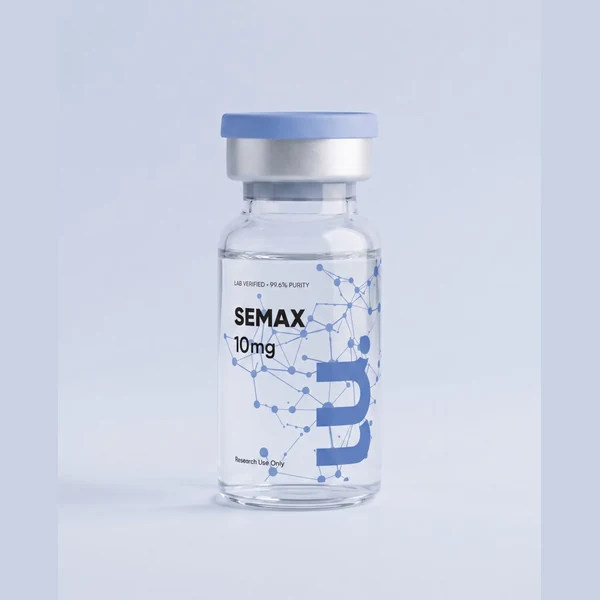
A certificate of analysis (COA) for a research peptide should contain five elements at minimum: a batch or lot number tying the document to a specific production run, an HPLC chromatogram with a stated purity percentage, a mass spectrometry result confirming the molecule's identity by molecular weight, the name and, ideally, accreditation of the testing laboratory, and the date of analysis. A COA missing any of these is incomplete, and a generic COA that is not tied to the specific batch shipped is not verifying the vial in hand at all. This applies equally to a hero compound such as Semax and to every other product in the catalogue.
What is a certificate of analysis?
A COA is a laboratory report generated for a specific production batch of a compound, documenting the analytical tests performed on a sample from that batch and their results. In the context of research peptides, its purpose is to give the researcher independent evidence — or at least documented evidence — that the vial contains the labelled sequence at the stated purity, rather than a different compound, a degraded sample, or a mixture. A COA is a claim of testing, and its usefulness scales directly with how verifiable that testing is: which laboratory performed it, whether that laboratory is independent of the seller, and whether the batch number on the document matches the batch number on the vial.
What does the HPLC section show?
High-performance liquid chromatography (HPLC) separates the components of a sample by how they interact with a chromatography column, producing a chromatogram in which each distinct compound appears as a peak at a specific retention time. Purity is typically reported using the area normalisation method: the area under the target peptide's peak is divided by the total area under all peaks in the trace, expressed as a percentage. A COA showing ≥99% purity by this method means that peak-area calculation, not a statement that the sample is chemically pure in an absolute sense. The mechanics and limits of this method are explained in full in what HPLC purity actually measures.
What does the mass spectrometry section confirm?
HPLC purity data says nothing about whether the major peak is actually the intended peptide — it could, in principle, be a different compound with similar chromatographic behaviour. Mass spectrometry closes that gap by measuring the mass-to-charge ratio of ionised molecules in the sample, most commonly via electrospray ionisation (ESI) or matrix-assisted laser desorption/ionisation (MALDI). A COA should report an observed molecular weight that matches the calculated molecular weight for the labelled sequence within an acceptable tolerance. For Semax, that reference figure is a molecular weight of 813.9 g/mol for the free-acid form; a COA reporting a substantially different mass, without explanation, indicates either a different compound or a modified terminus that should be disclosed on the label.
Why does the batch or lot number matter?
Peptide synthesis is a batch process, and purity, yield and trace impurity profile can vary meaningfully from one production run to the next, even for the same sequence made by the same manufacturer. A COA that is not tied to a specific batch number — or a vendor that reuses one COA across multiple batches — is not documenting the material actually shipped. The batch number printed on the vial label should match the batch number on the COA exactly; if it does not, the document proves nothing about the contents of that specific vial.
What does independent laboratory verification add?
A COA generated in-house by the manufacturer or seller is a useful starting point but carries an inherent conflict of interest. Third-party verification — testing performed by a laboratory with no commercial relationship to the seller — removes that conflict and is the standard a careful researcher should look for, particularly for a hero compound such as the Semax reference vial or other high-specification material like BPC-157 or tirzepatide. The purity and COA page on this site documents how batch verification is handled for the full catalogue.
What should raise questions on a COA?
A short list of warning signs is worth keeping in mind when reviewing any COA: a stated purity with no visible chromatogram or peak data behind it, a mass spectrometry result that is missing entirely, a testing date that predates the batch number by an implausible margin, or a document that is a generic template rather than one addressed to a specific batch. A fuller checklist for evaluating a vendor beyond the COA alone is covered in spotting a low-quality research peptide vendor, and the documentation researchers should expect for a UK or EU order is covered in buying research peptides in Europe.
What specific numbers on a COA deserve a closer look?
Beyond the presence or absence of HPLC and mass spectrometry sections, several numerical details separate a rigorous COA from a superficial one. A purity figure reported as an exact round number — precisely 99.00%, with no decimal variation across multiple batches — is worth treating with some scepticism, since real chromatographic runs on independent batches rarely land on identical figures. Mass spectrometry results should state a tight tolerance: on modern LC-MS instrumentation, mass accuracy in the low parts-per-million range is achievable, so a result quoted only to a coarse tolerance such as ±0.1% leaves enough margin to obscure a truncated or substituted sequence on a mid-sized peptide. Where a compound is intended for any application involving injectable-grade handling, an endotoxin result should be reported in EU/mg rather than as a bare pass/fail, since a pass/fail result alone does not communicate how close the sample came to the relevant threshold.
| COA element | Stronger signal | Weaker signal |
|---|---|---|
| Purity figure | Specific value with visible chromatogram | Round number, no chromatogram image |
| Mass spec tolerance | Tight, stated tolerance (ppm-level) | Coarse tolerance or no tolerance stated |
| Testing lab | Named, ideally accredited (e.g. ISO 17025) | Unnamed or in-house only |
| Batch match | Batch number matches vial label exactly | Generic or undated document |
How reliable is a vendor-issued COA on its own?
Independent, third-party retesting programmes in the research peptide sector have reported that a meaningful proportion of vendor-issued COAs do not fully match results obtained on independent retesting, with discrepancies sometimes running several percentage points below the figure stated on the original document. This does not mean every vendor-issued COA is unreliable, but it is a reasonable basis for treating a self-reported figure as a starting point rather than a final answer, particularly for a study where purity materially affects the interpretation of results. Where a specific study demands a higher confidence level than a single vendor COA provides, commissioning independent retesting from an accredited laboratory remains the most reliable option.
Reading a COA carefully is a research use only exercise in verifying laboratory documentation, not a substitute for independent testing where a study demands it. Every batch listed in the catalogue ships with its own COA, and the guide to buying research Semax walks through the ordering process end to end.