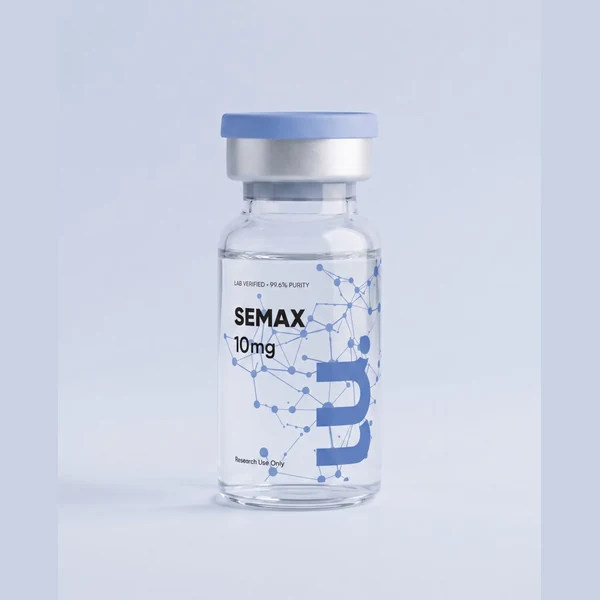
ACTH(4-10) fragment peptides are a research family built on the observation, first reported in the 1970s, that a short N-terminal segment of adrenocorticotropic hormone influences learning and attention-related behaviour in animal models without engaging the adrenal-stimulating activity of the full-length hormone — a family that includes the original ACTH(4-10) fragment itself, the Dutch-developed analogue ORG 2766, and the Russian-developed analogue Semax. Background on Semax specifically is covered on the Semax research pillar page; this article traces the broader fragment family it belongs to.
Where does the ACTH(4-10) fragment come from?
Adrenocorticotropic hormone (ACTH) is a 39-amino-acid peptide cleaved from pro-opiomelanocortin (POMC) and released by the pituitary gland, where its principal role is to stimulate cortisol production in the adrenal cortex. Researchers studying shorter ACTH fragments reported that the 4-10 region — a seven-residue segment near the hormone's N-terminus — produced measurable effects on learning and avoidance behaviour in rodent and early human studies while carrying essentially none of the corticotropic activity of the intact hormone, since the adrenal-stimulating domain sits elsewhere in the molecule. That separation between behavioural and endocrine activity is the founding observation behind the entire ACTH(4-10) fragment research programme.
Why was the native ACTH(4-10) fragment limited as a research tool?
The unmodified ACTH(4-10) fragment is degraded rapidly by peptidases circulating in blood and cerebrospinal fluid — a study of N-terminal degradation in rat blood identified aminopeptidase-mediated cleavage as a major route of breakdown for the native fragment, limiting how long it persists in a biological system after administration. That instability is what motivated two separate, parallel research efforts to design more stable analogues: one centred at Organon in the Netherlands, producing ORG 2766, and one centred at the Institute of Molecular Genetics in the Soviet Union, producing Semax.
What was ORG 2766 and how does it relate to this fragment family?
ORG 2766, an ACTH(4-9) analogue developed by Organon, was reported in the pharmacology literature to be roughly a thousand times more potent than ACTH(4-10) in comparable behavioural assays, despite lacking measurable affinity for the melanocortin receptors expressed in brain tissue. Researchers studying ORG 2766 reported that it instead modulated endogenous opioid activity and NMDA-receptor function, proposed as an indirect route to the attentional and recovery-related effects reported in animal models of brain injury. ORG 2766 and Semax represent two independently engineered solutions to the same underlying stability problem in the same fragment family, developed in different countries without a shared research lineage.
How does Semax's stabilisation strategy differ?
Rather than modifying the ACTH(4-7) core itself, Semax appends a Pro-Gly-Pro (PGP) tripeptide to the C-terminus of the fragment, which the literature reports as sterically hindering carboxypeptidase activity and extending the compound's stability in biological fluid relative to the unmodified ACTH(4-10) fragment. A rat hippocampus study reports that this stabilised analogue produces measurable increases in BDNF protein and mRNA alongside enhanced TrkB receptor phosphorylation — a mechanism distinct from the opioid- and NMDA-receptor pathways reported for ORG 2766, illustrating that structurally related fragment analogues can be studied through different downstream mechanisms. The chemistry of Semax's stabilisation is covered in more depth in Semax stability and degradation.
How does this fragment family relate to the wider melanocortin peptide research area?
ACTH and the melanocyte-stimulating hormones (MSH) share a common precursor, POMC, and a family of melanocortin receptors, which places ACTH(4-10) fragment research within a broader area of peptide science that also includes MSH-derived research compounds such as Melanotan II. The two research lines are not interchangeable — Melanotan II research centres on melanocortin receptor agonism relevant to pigmentation pathways, while ACTH(4-10) fragment research centres on behavioural and neurotrophin outcomes reported independently of classical melanocortin receptor engagement — but both trace back to the same POMC precursor family, which is a useful point of reference when mapping how different peptide research areas relate structurally.
Where does Selank fit into this history?
Selank was developed by the same Institute of Molecular Genetics group responsible for Semax, using the identical PGP stabilising tail but built on a tuftsin-derived core rather than an ACTH fragment — a related engineering strategy applied to a different parent hormone. The shared research programme behind both compounds, including the researchers who led it, is covered in the research history behind Semax and Selank.
What happened to ORG 2766 as a research compound over time?
ORG 2766 was studied through the 1980s and 1990s primarily in the context of recovery after brain injury and in aging-related cognition research, with a substantial literature examining its effects following experimental brain lesions in animal models. Unlike Semax, ORG 2766 did not go on to widespread commercial availability as a research reagent, and most of its literature remains concentrated in that earlier period rather than continuing to expand the way the Semax literature has. This is a useful data point for a researcher assessing how active a given line of fragment research remains today: publication activity, not just historical significance, is part of what determines how current a compound's evidence base is.
Are there other ACTH(4-10)-related analogues studied in the literature?
Beyond Semax and ORG 2766, researchers in the original ACTH(4-10) programme also examined variants such as [D-Phe7]ACTH(4-10), a fragment carrying a D-amino-acid substitution studied specifically for its effects on duration of action in avoidance-behaviour tasks compared with the parent fragment and with ORG 2766. This family of closely related analogues illustrates how a single core finding — that a short ACTH fragment influences behaviour independently of adrenal activity — generated multiple, independently engineered research compounds over the following decades, each with its own stability and potency profile rather than a single settled structure-activity relationship.
How does this history inform how Semax's literature should be read today?
Reading Semax as one branch of a broader ACTH(4-10) fragment research tradition, rather than as an isolated compound, helps explain why its literature so consistently frames findings against the unmodified fragment as a reference point — the degradation and potency comparisons only make sense in that context. A researcher building a citation trail around Semax benefits from tracing findings back through this fragment family rather than treating the compound's literature as self-contained, a synthesis attempted more broadly in the Semax research overview.
What does molecular size have to do with how these fragments are classified?
ACTH(4-10) and its analogues sit at the short end of the peptide size range — seven or fewer residues — which places them closer in scale to Selank than to considerably longer research peptides in the catalogue, and which is part of why they can be synthesised and purified to high HPLC purity at comparatively modest cost. This size class also makes mass spectrometry identity confirmation straightforward, since a short, defined sequence has a single calculable molecular weight against which an observed mass can be checked directly.
This fragment family remains, more than four decades after the original ACTH(4-10) observations, a research area studied through gene-expression and behavioural endpoints in animal models, for research use only. Practical guidance on ordering a reference-grade batch, including how COA documentation is issued, is set out in the guide to buying research Semax. Semax and the rest of the verified peptide range are available in the catalogue with batch-specific documentation.