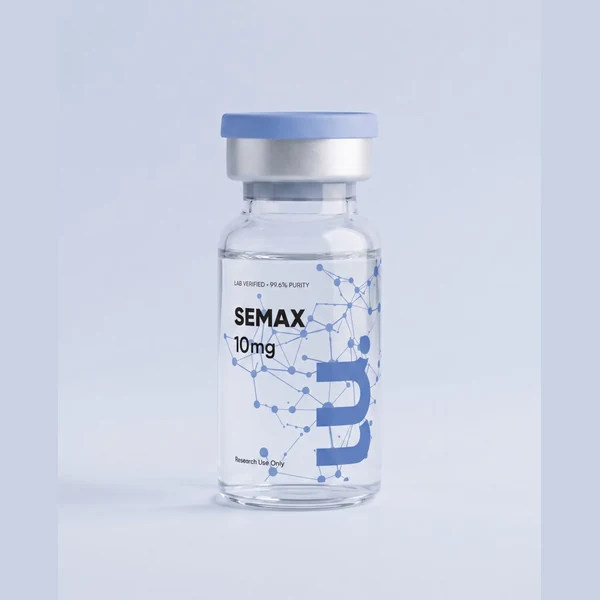
The Semax literature centres on three reported findings in rodent studies: increased BDNF/TrkB gene and protein expression in hippocampus, favourable gene-expression changes in cerebral ischemia–reperfusion models, and behavioural changes on learning and avoidance tasks. The important caveat is that most of this evidence comes from animal models and from Russian-language clinical literature that has not been independently replicated to the standard expected by EU or US regulatory bodies, so it should be read as a preclinical research base rather than as settled clinical evidence. Background on the compound itself, including its origin and structure, is covered on the Semax research pillar page, which this overview complements with a closer look at the evidence base specifically.
What does the BDNF/TrkB literature report?
Brain-derived neurotrophic factor (BDNF) and its receptor TrkB are the most consistently studied endpoint in the Semax literature. A rat hippocampus study reports that a single application of Semax at 50 µg/kg body weight produced approximately a 1.4-fold increase in BDNF protein and a 3-fold increase in exon III BDNF transcript, together with a 1.6-fold increase in TrkB tyrosine phosphorylation. A separate study published in the Journal of Molecular Neuroscience (PMID 19662538) compared the time course of BDNF and NGF gene expression across hippocampus, frontal cortex and retina following Semax administration in rats, and reported tissue-specific differences in the timing of that induction. Background on the BDNF/TrkB pathway itself, and why it recurs across this literature, is covered separately in BDNF and neurotrophic research.
What do cerebral ischemia models show?
A second body of work uses the transient middle cerebral artery occlusion (tMCAO) model in rats, a standard laboratory model of ischemic stroke. A 2021 study in the International Journal of Molecular Sciences (PMC8226508) applied genome-wide RNA-Seq and protein-expression profiling to this model and reported that Semax treatment was associated with suppressed transcription of inflammation-related genes, reduced expression of matrix metalloproteinase-9 (MMP-9) in tissue adjacent to the ischemic focus, and earlier upregulation of BDNF, TrkA and TrkC relative to untreated controls. The authors frame these as gene- and protein-expression outcomes measured at fixed time points after occlusion in a rodent model, not as a description of recovery in any individual animal, let alone a person.
What behavioural and cognitive endpoints have been studied?
A smaller set of studies looks at behavioural endpoints in mice and rats, most commonly conditioned avoidance response tasks and maze-based learning paradigms. Semax-treated animals are reported to show increased rates of conditioned avoidance acquisition relative to controls in some of these protocols. Separately, comparative studies in BALB/c mice have examined Semax alongside Selank and Noopept and reported route-dependent differences in which behavioural domain — broadly described as nootropic-leaning versus anxiolytic-leaning — predominates depending on how the peptide is administered. That three-way comparison is explored further in Semax vs other nootropic-class peptides.
What are the limits of the current evidence base?
Three limitations are worth stating plainly for anyone designing a study around this literature. First, species: almost all of the mechanistic data comes from rat and mouse models, and gene-expression responses reported in rodents do not automatically generalise across species. Second, route and dose heterogeneity: published studies use a range of administration routes and doses that are not always directly comparable to one another, which complicates cross-study synthesis. Third, independent replication: a meaningful share of the clinical-context literature originates from a small number of Russian research groups and has not been replicated by independent laboratories outside that network to the extent expected for EU regulatory acceptance. None of this invalidates the preclinical signal reported in the gene-expression and ischemia-model studies; it simply means the evidence base should be read as active, ongoing research rather than as an established clinical fact.
How does this compare with related compounds?
Researchers studying the Semax reference vial frequently study it alongside Selank, given the shared PGP-stabilised heptapeptide architecture and common Russian research origin. The structural relationship between the two, and how it maps onto their reported mechanisms, is set out in the Semax vs Selank guide. Readers new to the compound should start with what Semax is and where it comes from before working through the mechanistic literature summarised here.
What research questions remain open?
Several questions in the Semax literature are still actively studied rather than settled. Dose-response characterisation is incomplete: most published gene-expression studies use a single dose or a narrow range, which leaves the shape of the dose-response curve for BDNF induction poorly mapped across the full range used in different Russian clinical protocols. Route of administration is another open variable — intranasal, subcutaneous and intraperitoneal routes have all appeared in different rodent studies, and the literature has not fully reconciled how route affects the magnitude or timing of the reported neurotrophin response. Long-term outcomes are also under-studied: the majority of the ischemia-model literature measures gene and protein expression at fixed, relatively short time points (24–72 hours post-occlusion), rather than following outcomes over weeks, so claims about durability of any reported effect exceed what the published data currently supports.
How should a researcher weigh Russian-language sources against the wider literature?
A meaningful share of the foundational Semax literature was published in Russian-language journals before later appearing, sometimes in abbreviated form, in English-language indexed publications. This is a citation-tracking issue as much as a scientific one: a researcher building a literature review around Semax should expect to reconcile findings across both source bases, note where English abstracts summarise but do not fully reproduce the original Russian methodology, and treat translation and indexing gaps as a limitation of the secondary literature rather than of the underlying research itself. Where this site cites a specific journal and identifier — as with the PMC and PubMed references above — that indicates the finding is independently indexed and retrievable through standard bibliographic databases, which is a useful practical filter when prioritising which papers to review first.
A practical consequence of this fragmented publication history is that meta-analyses of the Semax literature remain scarce: most reviews to date are narrative summaries of a handful of frequently cited studies rather than systematic, pooled analyses of every available data set, in part because the studies are not always methodologically comparable enough to pool statistically. A researcher relying on this site's summary, or on any single secondary source, should treat it as a starting map of the literature rather than a substitute for reading the primary papers directly, particularly before citing a specific figure such as the fold-change values reported for BDNF or TrkB expression.
Every reference cited above is attributed to a specific animal model and, where available, a journal and identifier, in keeping with how the evidence should be read: as findings reported in defined laboratory conditions, for research use only. The full catalogue of verified research compounds, including Semax, is available in the catalogue.