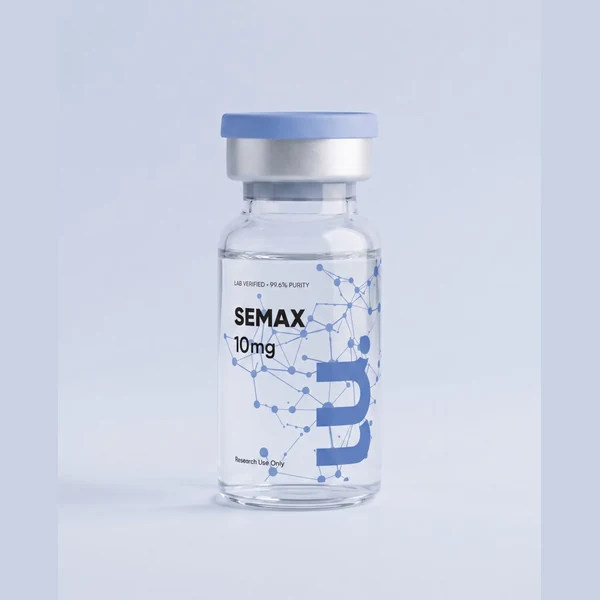
Semax is a synthetic heptapeptide, sequence Met-Glu-His-Phe-Pro-Gly-Pro, built around the 4–10 fragment of adrenocorticotropic hormone (ACTH) and first synthesised in the early 1980s at the Institute of Molecular Genetics of the Russian Academy of Sciences. It is a laboratory compound rather than a hormone: the ACTH(4–10) fragment carries none of the corticotropin activity that drives the adrenal axis, which is why the original research programme, led by Nikolai Myasoedov and colleagues, selected it as a scaffold for central-nervous-system research rather than endocrine research.
Where does the ACTH(4-10) fragment come from?
Adrenocorticotropic hormone is a 39-amino-acid peptide cleaved from the larger precursor pro-opiomelanocortin (POMC) and released by the pituitary gland, where its principal role is to stimulate cortisol production in the adrenal cortex. Researchers in the 1970s reported that short N-terminal fragments of ACTH, particularly the 4–10 region, produced measurable effects on learning and attention tasks in animal models without engaging the adrenal-stimulating activity carried by the full-length hormone. That observation is the starting point for the entire Semax research programme: the fragment isolates a central-nervous-system signal reported in the literature from the hormonal signal carried by intact ACTH.
The native ACTH(4–10) fragment is degraded within minutes by peptidases circulating in blood and cerebrospinal fluid, which limited its usefulness as a stable research tool. Semax was designed specifically to address that instability.
How is the Semax molecule stabilised against enzymatic breakdown?
The Semax sequence appends a Pro-Gly-Pro (PGP) tripeptide to the C-terminus of the ACTH(4–7) core (Met-Glu-His-Phe). The literature describes the proline residues in the PGP tail as sterically hindering aminopeptidase and carboxypeptidase activity, which extends the compound's stability in biological fluid relative to the unmodified ACTH fragment. This is a structural modification, not a functional one: the added tripeptide does not itself correspond to a known hormone fragment, it functions as a protective cap. Later variants, including N-Acetyl Semax amidate, modify both termini further for additional resistance to plasma enzymes — a distinction covered in more depth in the comparison of Semax forms and variants.
What does the preclinical literature report on Semax?
The published research base on Semax spans more than four decades and is concentrated in Russian-language and, increasingly, English-language peer-reviewed journals. Two lines of study dominate. The first examines gene and protein expression: a rat hippocampus study reports that a single application of Semax produced roughly a 1.4-fold increase in BDNF protein and a 3-fold increase in exon III BDNF mRNA, alongside changes in TrkB receptor phosphorylation. The second line examines cerebral ischemia–reperfusion models: a 2021 study in the International Journal of Molecular Sciences (PMC8226508) using a rat transient middle cerebral artery occlusion model reports that Semax administration is associated with earlier upregulation of neurotrophin genes (BDNF, NGF, NT-3) and suppression of inflammation-related gene expression in tissue adjacent to the infarct. A fuller summary of this evidence base, and its limits, is covered in the Semax research overview.
None of this literature describes outcomes in unsupervised human use. The studies are conducted in defined animal models, principally rat, under controlled laboratory conditions, and the reported findings are gene-expression and protein-level measurements in those models — not claims about any individual's experience.
How does Semax compare with other Russian-origin research peptides?
Semax is one of several heptapeptides to emerge from the same research programme. Selank, a tuftsin-derived heptapeptide sharing the same PGP stabilising tail, is studied for a different receptor target — allosteric modulation of the GABA-A receptor rather than the neurotrophin pathway most associated with Semax. The two compounds are frequently studied side by side in the literature, a comparison detailed in the guide on Semax versus Selank and in the broader survey of Semax against other nootropic-class peptides such as Noopept and Cerebrolysin.
Is Semax an approved medicine anywhere?
Semax is registered as a pharmaceutical product in Russia, where it is manufactured under licence and marketed there under specific indications, including post-stroke recovery protocols and cognitive research contexts. That registration is a Russian regulatory fact, not a European or international one: no EU or UK authority has evaluated Semax for any indication, and it is not classified as a medicine in the EU. SemaxBuy sells the compound exclusively under a research use only framework, as a laboratory reagent for qualified researchers rather than a finished pharmaceutical product.
What does research use only mean in practice?
Every Semax vial listed on SemaxBuy, including the Semax 10mg reference vial, is supplied as a research reagent verified to ≥99% purity by HPLC and mass spectrometry, with a certificate of analysis (COA) issued per batch. It is not formulated, labelled or sold as a medicine, and none of the material on this site describes a dosing regimen for human administration. The pillar page on Semax research collects the primary literature, the current COA library, and links to every related guide on this site.
What dose ranges appear in the published Russian clinical literature?
Russian clinical research on Semax, conducted under that country's own pharmaceutical framework and published mainly in Russian-language neurology journals, has studied intranasal administration across a range of concentrations depending on the study. A 110-participant non-randomised trial reported in Zh Nevrol Psikhiatr Im S S Korsakova (Gusev, Martynov and colleagues, 2018) describes a regimen of 6,000 µg per day delivered intranasally over two 10-day courses separated by a 20-day interval, in the context of post-ischemic recovery research. Other observational reports in the same literature describe daily intranasal totals as low as 200 µg and, in some acute hospital-based protocols, considerably higher concentrated solutions. This range illustrates a point worth underscoring: published dose figures vary substantially by study design, patient population and clinical context, and none of them constitute guidance for use outside a supervised hospital research protocol in the jurisdiction where the trial was conducted. SemaxBuy reports these figures as they appear in the literature for research and citation purposes only.
What is the full molecular profile of the reference compound?
The reference Semax molecule has the formula C₃₇H₅₁N₉O₁₀S and a molecular weight of 813.9 g/mol, figures that any COA for the compound should reproduce closely when confirmed by mass spectrometry. Its seven residues break down as: methionine (N-terminus, the site of acetylation in the modified variant), glutamic acid, histidine, phenylalanine — together forming the ACTH(4–7) core — followed by the Pro-Gly-Pro stabilising tripeptide at the C-terminus. The compound is a white to off-white lyophilised powder under standard laboratory conditions, freely soluble in water, with the free amine and free acid termini of the base form giving it net charge characteristics distinct from the N-Acetyl amidated variant discussed in Semax forms and variants. This physicochemical profile, rather than any single reported effect, is what a COA and an HPLC/mass-spectrometry pairing are ultimately verifying.
Semax remains, more than four decades after its synthesis, primarily a research tool: a stable, well-characterised fragment analogue used to study how a defined structural change to a hormone precursor alters gene expression in the central nervous system. All material on SemaxBuy — including neighbouring compounds in the peptide catalogue — is intended strictly for laboratory research use only, and researchers evaluating the compound should review the full catalogue alongside the primary literature before drawing conclusions.