N-Acetyl Semax Amidate is a chemically modified analogue of Semax that circulates widely in the research-peptide market, frequently marketed as a more stable alternative to the parent molecule. This guide explains the chemistry behind that claim, what changes and what does not, and — importantly — what the modified molecule does and does not share with Semax's published research record. It is a companion to the Semax research overview.
What the modification is
Unmodified Semax is the free heptapeptide Met-Glu-His-Phe-Pro-Gly-Pro, with a free amine at the N-terminal methionine and a free carboxylic acid at the C-terminal proline. N-Acetyl Semax Amidate carries an acetyl group capping the N-terminal amine (Ac-Met-Glu-His-Phe-Pro-Gly-Pro) and an amide group in place of the free C-terminal acid (...Pro-NH2). Both modifications are standard peptide-chemistry techniques used across many peptide families, not unique to this molecule, and both are designed to block a specific route of enzymatic attack rather than to alter the peptide's receptor-binding sequence.
Neither modification changes the four central residues — Met-Glu-His-Phe — that the Semax literature identifies as the core ACTH(4-7) fragment carrying central nervous system activity independent of ACTH's corticotropic effect. In principle, capping both termini leaves that core sequence intact while altering only how quickly the surrounding peptide bonds are recognised by exopeptidases. Whether that chemical logic translates into equivalent biological activity for the modified molecule, however, is a separate empirical question from the structural argument itself, and it is not one the published record currently answers with the same depth of evidence available for unmodified Semax.
Why the modification is made: the degradation chemistry
The rationale traces back to early degradation studies on unmodified Semax. Potaman and colleagues, working with rat blood enzymes, identified aminopeptidase-mediated cleavage of the N-terminal methionine and glutamate residues as a major route of ACTH(4-10) and Semax breakdown in serum, alongside a contribution from angiotensin-converting enzyme; the paper also reported that unmodified Semax was more resistant to enzymatic breakdown than the unmodified ACTH(4-10) fragment it derives from (Potaman et al., 1991, Biochemical and Biophysical Research Communications). Because aminopeptidases require a free N-terminal amine to initiate cleavage, N-terminal acetylation is a standard chemical strategy for blocking that specific degradation pathway; C-terminal amidation is a parallel strategy aimed at carboxypeptidase resistance. A separate rat pharmacokinetic study using radiolabelled Semax reported that, after intranasal administration, the peptide reached brain tissue within two minutes but underwent rapid enzymatic breakdown, with the tripeptide Pro-Gly-Pro recovered as the predominant metabolite in biological samples (Shevchenko et al., 2006, Russian Journal of Bioorganic Chemistry) — the kind of rapid in vivo turnover that N-terminal and C-terminal capping strategies are generally intended to slow.
What the literature does and does not cover
It is important for researchers to be precise about which molecule a given citation actually refers to. The core Semax pharmacology literature — the BDNF and TrkB findings (Dolotov et al., 2006) and the monoaminergic-activation findings (Eremin et al., 2005) — was generated using unmodified Semax, not the N-acetylated, C-amidated analogue. Chemical stability is not the same property as biological activity: a molecule that resists a specific enzymatic cleavage route may still differ from its parent compound in receptor affinity, distribution or metabolite profile, and that comparison has a much smaller independent published record for the acetylated variant. Researchers designing a protocol around a specific published finding should confirm which exact molecule — and, where possible, which exact supplier and batch — the original study used, rather than assuming interchangeability based on structural similarity alone.
Sourcing considerations
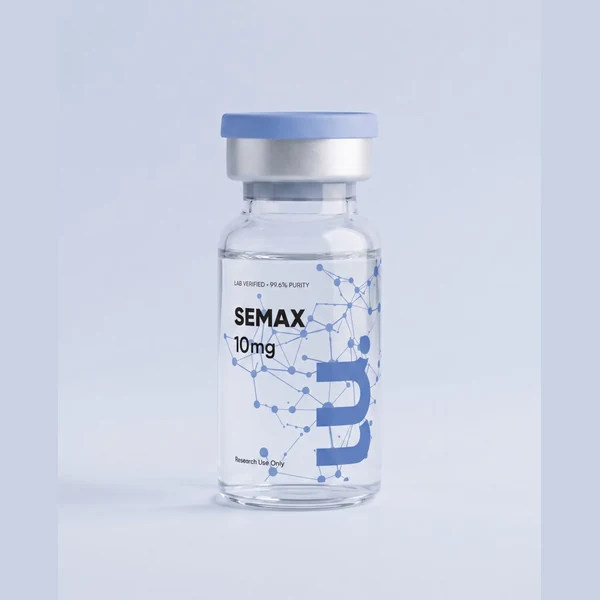
Because "N-Acetyl Semax Amidate" is a market label rather than a name tied to a single manufacturing standard, purity verification matters at least as much as it does for unmodified Semax, and arguably more, given the thinner independent literature available to cross-check a supplier's identity claims against. Any batch should carry a certificate of analysis reporting HPLC purity and mass-spectrometry-confirmed identity specific to that batch. SemaxBuy's own catalogue carries standard, unmodified Semax — see Semax 10mg — verified in the same way; general guidance on evaluating a supplier's documentation is set out in How to source research-grade Semax in Europe, and handling practice once a peptide is reconstituted is covered in Peptide reconstitution and storage in the laboratory. All peptides referenced on this site, modified or unmodified, are supplied for research use only, not for human or veterinary administration.
Naming inconsistency in the wider market
Buyers should be aware that "N-Acetyl Semax Amidate" is not a standardised INN-style name governed by any regulatory nomenclature body; it is a descriptive label that different suppliers apply with varying precision. Some listings abbreviate it to "NA-Semax" or "Semax Amidate" without specifying whether both the N-acetyl and the C-amide modifications are actually present, and a small number of listings online use the name loosely for products that, on independent mass-spectrometry testing, do not match the expected molecular weight for the fully modified sequence. This is precisely the kind of discrepancy a batch-specific certificate of analysis is designed to catch, and it is a stronger reason to insist on one for this analogue than for better-standardised compounds.
Why SemaxBuy carries unmodified Semax
SemaxBuy's own catalogue is built around unmodified Semax rather than the N-acetylated analogue, on the reasoning set out through this guide: the published pharmacology record — the BDNF and TrkB findings, the monoaminergic-activation findings, and the ischaemia and Russian clinical literature summarised on the Semax research overview — was generated using the unmodified molecule, and a research buyer working from that literature is best served by material that matches it directly rather than by a structurally related but independently under-characterised alternative.
How the two molecules are distinguished analytically
Because the two sequences differ only at the termini, distinguishing them on paper is simple but distinguishing a mislabelled vial requires the same analytical tools discussed throughout this guide series. N-terminal acetylation adds a small, fixed mass increment relative to the free amine, and C-terminal amidation replaces a hydroxyl with an amine group, each producing a small but detectable shift in the molecule's total mass compared with unmodified Semax. A mass-spectrometry identity check that reports the observed molecular weight against the expected value for the specific labelled compound is therefore capable of confirming — or contradicting — a supplier's claim about which of the two molecules a given vial actually contains, in a way that a purity percentage alone cannot. This is the practical, laboratory-level reason the sourcing guidance in How to source research-grade Semax in Europe insists on mass-spectrometry identity confirmation and not HPLC purity data alone.
Summary for researchers comparing the two
The practical takeaway for a researcher choosing between the two molecules is narrower than marketing copy for either tends to suggest. Structurally, N-Acetyl Semax Amidate is a reasonable, standard chemistry approach to slowing a specific, published degradation pathway identified in unmodified Semax. Scientifically, it is a distinct research subject with a far thinner independent literature, and any claim about its behaviour that is not backed by a citation specific to the modified molecule should be treated as an extrapolation from Semax data rather than as an established finding in its own right. SemaxBuy's position, reflected in its catalogue, is to carry the molecule with the deeper, better-characterised published record and to be explicit about that distinction rather than blur it, which is the purpose of this guide.