Base Semax and N-Acetyl Semax amidate share the identical Met-Glu-His-Phe-Pro-Gly-Pro amino acid backbone; the difference between them is confined to the two ends of the molecule, where an acetyl group is added to the N-terminus and the C-terminal carboxyl group is converted to an amide. Both modifications are reported in the literature to slow enzymatic degradation, which is why the variant exists as a separate research reagent rather than a replacement for the base compound. General background on Semax is covered on the Semax research pillar page; this article focuses specifically on the chemistry that separates the two forms.
What is unmodified Semax?
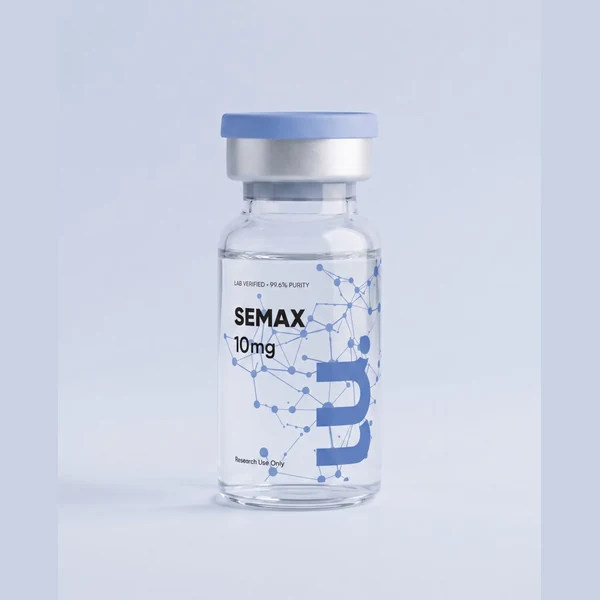
Unmodified, or "base", Semax is the heptapeptide as originally synthesised at the Institute of Molecular Genetics: a free amine at the N-terminus (on the methionine residue) and a free carboxylic acid at the C-terminus (on the terminal proline). This is the form used in the majority of the foundational gene-expression and ischemia-model literature discussed in the Semax research overview, and it is the form listed as the Semax 10mg reference vial on this site.
What changes in N-Acetyl Semax amidate?
N-Acetyl Semax amidate carries two terminal modifications relative to the base compound. An acetyl group (CH₃CO–) is attached to the free amino terminus of the methionine residue, and the terminal carboxyl group is converted to a primary amide (–CONH₂) rather than remaining a free acid. Neither modification changes the seven-residue amino acid sequence itself — the peptide backbone and side chains are unchanged — the modifications sit only at the two termini, which is exactly where peptidases initiate degradation. This distinction, and the naming convention that follows from it, is set out in full in the guide on N-Acetyl Semax amidate.
Does acetylation and amidation change stability in the literature?
Terminal acetylation and amidation are established peptide-chemistry strategies for improving resistance to exopeptidase activity, and the peptide chemistry literature reports that N-terminal acetylation in particular slows degradation by plasma aminopeptidases; some reports describe the modified peptide resisting breakdown for a longer window than the unmodified sequence under comparable in-vitro conditions. Acetylation is also reported to modestly increase lipophilicity, which is discussed in the literature as a potential factor in blood–brain barrier permeability, though this remains an area of active study rather than an established finding. None of this describes an outcome for a person; it describes the physicochemical behaviour of the molecule itself, as measured in vitro and in animal pharmacokinetic studies.
Do these modifications change what the research reports functionally?
The gene-expression and receptor-binding studies conducted on base Semax do not automatically transfer to the N-Acetyl amidated form, and researchers should treat the two as related but analytically distinct reagents rather than interchangeable material. Where a protocol specifies base Semax, substituting the amidated variant introduces a variable that has not necessarily been characterised in that specific experimental context, and vice versa. This is a standard consideration in peptide research generally, not something unique to Semax: Selank and other PGP-stabilised heptapeptides in this research family raise the same consideration when structural analogues are substituted for a reference sequence. A protocol document should always specify which form is being handled, and a study report should carry that specification through to its methods section, so that a reader comparing two papers can tell whether they are looking at the same reagent.
Which form appears in which studies, and how should a COA be read for either?
Most of the historical gene-expression and ischemia literature cited across this site uses unmodified Semax, since that is the form originally developed and most extensively characterised. The N-Acetyl amidate variant appears more often in newer, stability-focused and pharmacokinetic research. Regardless of which form a batch of research material represents, the certificate of analysis should state the exact sequence and any terminal modification explicitly, alongside the HPLC purity and mass spectrometry confirmation of molecular weight — a modified terminus shifts the expected mass, so a COA that fails to specify the form is missing information a researcher needs. The mechanics of reading that documentation are covered in how to read a peptide certificate of analysis.
How does molecular weight shift between the two forms?
Base Semax has a molecular weight of 813.9 g/mol (formula C₃₇H₅₁N₉O₁₀S). Acetylation adds a CH₃CO– group at the N-terminus, adding roughly 42 mass units, while amidation replaces the terminal –COOH with –CONH₂, a difference of approximately ‒1 mass unit at that position once the substitution is accounted for. Combined, the N-Acetyl amidated variant carries a distinct calculated molecular weight from the base compound, and a mass spectrometry result on a COA should reflect whichever form is labelled on the vial. This is precisely the kind of numerical check a researcher can perform directly against a COA without specialised equipment: compare the reported observed mass to the calculated mass for the specific form ordered, and treat any unexplained discrepancy as a reason to query the supplier before use.
Why does this distinction matter for citing prior literature correctly?
A literature review that cites a finding from a base-Semax study as though it applies equally to the N-Acetyl amidated form — or the reverse — introduces an error that is easy to make and easy to avoid. Because the two forms share the same core amino acid sequence, abstracts and secondary summaries do not always specify which terminal modification, if any, was used in a given experiment, which means the primary methods section is the only reliable source for that detail. Researchers assembling a comparative protocol across both forms — for instance to test whether terminal modification changes the magnitude of a reported BDNF response — should treat the base and modified sequences as two related but separately characterised reagents throughout their methods and results, consistent with how the primary literature summarised in the Semax research overview distinguishes between them.
How should labelling distinguish the two forms on a vial and a COA?
Because the difference between base and N-Acetyl amidated Semax sits entirely at the two molecular termini, clear labelling matters more here than for compounds where variants differ in overall sequence. A vial label and its accompanying COA should state the full form name — not simply "Semax" — together with the calculated and observed molecular weight for that specific form, so that a researcher can confirm at a glance which reagent is in hand without needing to infer it from context. Vendors that sell both forms should also avoid using the two names interchangeably in marketing copy, since doing so reintroduces exactly the ambiguity that careful terminal-modification labelling is meant to remove.
Whichever form is used, both are supplied on SemaxBuy strictly for laboratory research use only, verified against a reference standard and accompanied by a batch-specific COA. The full range, including related research compounds, is listed in the catalogue.