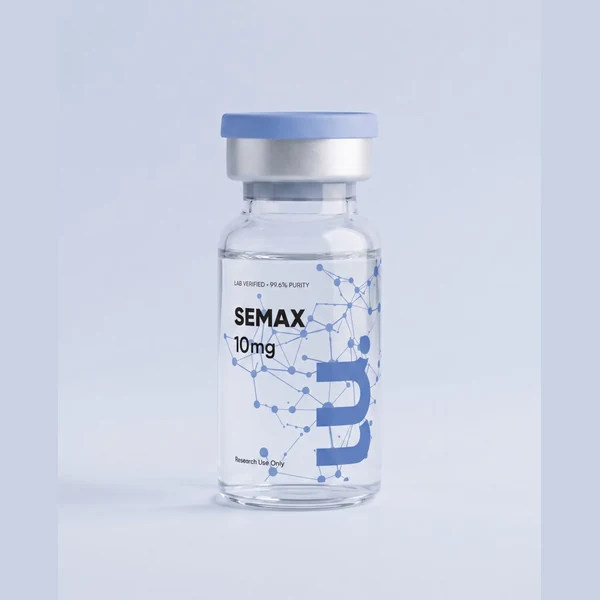
Semax is degraded in biological fluid primarily by aminopeptidases attacking its N-terminus, and the compound's Pro-Gly-Pro (PGP) tail was specifically designed to slow that process relative to the unmodified ACTH(4-10) fragment it is built from — which is also why a further-stabilised variant, N-Acetyl Semax amidate, exists as a separate research reagent. Background on the compound generally is covered on the Semax research pillar page; this article focuses specifically on what the degradation literature reports.
What enzymes degrade the Semax sequence?
A study examining N-terminal degradation of ACTH(4-10) and Semax by rat blood enzymes identified aminopeptidase-mediated cleavage of the N-terminal methionine-glutamic acid bond as a major route of breakdown for both the native fragment and its Semax analogue, reporting that Semax was more stable than unmodified ACTH(4-10) against the other enzymes studied in that work. This finding is the direct evidence behind the design rationale for Semax: the PGP tail addresses degradation from the C-terminal side, but the N-terminus of the methionine-glutamic acid-histidine-phenylalanine core remains a vulnerability shared with the parent ACTH fragment, a lineage covered in ACTH(4-10) fragment peptides.
What does the PGP tail actually protect against?
The Pro-Gly-Pro tripeptide appended to the Semax C-terminus is reported in the peptide chemistry literature to sterically hinder carboxypeptidase activity, the class of enzyme that cleaves peptide bonds from the carboxyl end inward. Proline residues in particular are poor substrates for many peptidases because of the constrained geometry proline imposes on the peptide backbone, which is the structural reason a short proline-containing tail can measurably slow degradation without requiring any change to the biologically relevant ACTH(4-7) core sequence at the other end of the molecule.
How quickly is Semax degraded once administered, according to the pharmacokinetic data?
A study tracking radiolabelled Semax after intranasal administration in rats reported detection of the compound in brain tissue within two minutes, alongside rapid enzymatic breakdown that yielded the Pro-Gly-Pro tripeptide itself as the predominant metabolite recovered in biological samples. That finding is informative in two directions at once: it confirms the compound reaches brain tissue quickly, a point developed further in why intranasal administration appears in the Semax literature, and it confirms that the PGP tail is itself eventually cleaved from the rest of the molecule rather than being permanently resistant to all degradation.
Why does a further-stabilised variant exist?
N-Acetyl Semax amidate modifies both termini of the same seven-residue backbone: an acetyl group is added to the free amine at the N-terminus, and the C-terminal carboxyl group is converted to a primary amide. Both modifications are reported to slow enzymatic degradation further than the PGP tail alone achieves, since acetylation directly blocks the aminopeptidase attack site identified as a major degradation route in the rat blood-enzyme study referenced above. The chemistry separating the two forms, and what changes when moving between them, is set out in full in Semax forms and variants and in the N-Acetyl Semax amidate guide.
What does degradation stability mean for how the reagent should be handled?
Enzymatic degradation in biological fluid is a distinct question from storage stability of the lyophilised or reconstituted compound outside the body, though both matter to a researcher designing a protocol. The blood-enzyme degradation discussed above describes what happens to Semax once it is in a biological system; separately, how the compound should be stored before that point — temperature, light exposure, freeze-thaw cycling — is covered in the peptide storage temperature guide. A batch that degrades in storage before use introduces a variable that the blood-enzyme literature does not address at all.
Does this degradation pathway differ from what is reported for Selank?
Selank shares the same PGP-stabilised C-terminal architecture as Semax, since both compounds emerged from the same Institute of Molecular Genetics research programme, but the two differ in their N-terminal core sequence — Selank derives from tuftsin rather than ACTH. Because the aminopeptidase vulnerability identified in the Semax degradation literature is specific to the methionine-glutamic acid bond at that compound's N-terminus, the same finding does not automatically transfer to Selank's different N-terminal sequence, and a researcher comparing degradation kinetics across both compounds should treat that as a variable requiring its own characterisation rather than an assumption.
How is degradation typically measured in the laboratory?
Researchers studying peptide degradation kinetics commonly incubate a compound in plasma, serum or a defined enzyme solution at physiological temperature and sample the mixture at successive time points, using HPLC to track the declining concentration of the intact parent peptide and the appearance of breakdown fragments over time. This kind of time-course study is what underlies statements such as the aminopeptidase-mediated degradation reported for ACTH(4-10) and Semax in rat blood, and it is a distinct analytical exercise from the single-timepoint HPLC purity check used to certify a fresh batch on a certificate of analysis, a distinction covered in what HPLC purity actually measures, and it applies to the Semax reference vial as much as to any other compound in the catalogue.
What role does the specific degradation product play in interpreting a study?
Identifying Pro-Gly-Pro as the predominant metabolite recovered after intranasal Semax administration in rats is informative beyond confirming that degradation occurs — it indicates where along the sequence the molecule is being cleaved, since PGP corresponds to the intact C-terminal tail separating cleanly from the ACTH(4-7) core. A degradation study that instead reported fragments corresponding to cleavage within the core sequence, rather than at the tail, would point to a different vulnerability and a different design implication for any further stabilisation effort. This kind of fragment-level detail is why methods sections in the degradation literature matter as much as the headline stability figure.
Does degradation rate differ between the base and modified forms in the literature?
The rat blood-enzyme study discussed above worked with unmodified Semax rather than the N-Acetyl amidated variant, so its specific degradation rate figures should not be assumed to transfer directly to the modified form without separate characterisation, even though the modification is designed with the same aminopeptidase vulnerability in mind. Researchers comparing degradation kinetics across both forms should treat published rate constants as form-specific rather than assuming acetylation shifts a rate uniformly, an issue closely related to the broader point about treating the two forms as related but analytically distinct reagents, covered in Semax forms and variants.
How does this degradation literature relate to shelf-life claims on a COA?
A certificate of analysis documents purity at the point of testing, not a guaranteed shelf life, and the enzymatic degradation kinetics discussed throughout this article describe what happens once a peptide is introduced into a biological system rather than what happens to a sealed, lyophilised vial sitting in a freezer. Conflating the two — reading a blood-enzyme degradation half-life as though it were a storage shelf-life figure — is a common misreading of this literature, and the two questions should be kept separate when evaluating a batch's documentation.
Everything above describes degradation kinetics reported in defined laboratory conditions, for research use only, and is not guidance for handling outside a research protocol. Every batch of Semax listed in the catalogue ships with batch-specific HPLC and mass spectrometry documentation.