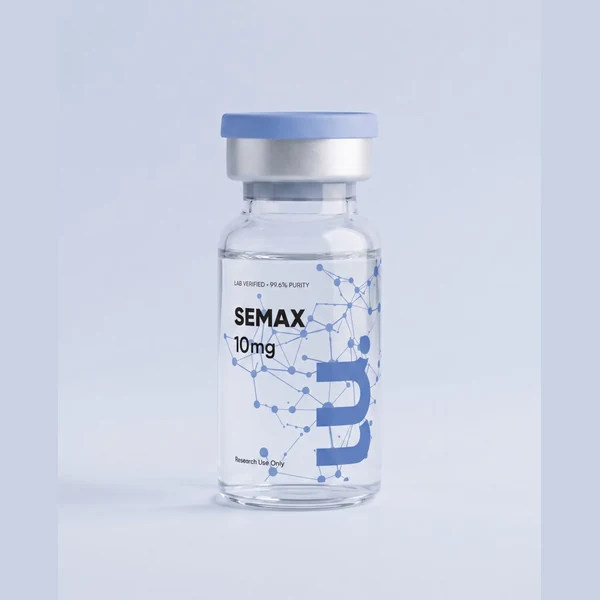
Semax is sold across the European research-chemical market by a wide range of suppliers of highly variable quality, and because the peptide degrades readily once out of lyophilised form (see the handling discussion in the reconstitution and storage guide), verifying what is actually in a vial matters more than it might for a more chemically stable reagent. This guide sets out what documentation a laboratory should expect from a supplier and what to treat as a warning sign. It assumes the reader already understands what Semax is and why it is studied; for that background see the Semax research overview.
Start with the certificate of analysis
A legitimate research-peptide supplier issues a certificate of analysis (COA) for each batch, not a generic specification sheet reused across every lot it sells. A batch-specific COA for Semax should report reversed-phase HPLC purity as a percentage (SemaxBuy's catalogue reports ≥99% purity by HPLC), a batch or lot number that can be matched to the physical vial received, and the date of analysis. If a supplier cannot produce a COA tied to the specific batch a buyer has received — offering instead a document dated years earlier, or one that does not reference a batch number at all — that is a reasonable basis for treating the listing with caution.
HPLC and mass spectrometry: what each method actually checks
Reversed-phase HPLC and mass spectrometry answer two different questions and a rigorous COA should report both. HPLC separates the target peptide from closely related synthesis by-products — truncated sequences, deletion sequences, incompletely deprotected intermediates — and reports the target peptide's proportion of total peak area, which is what "purity" means in this context. Mass spectrometry answers a different question: whether the molecule present actually has the expected molecular weight and elemental composition for Semax, which is the identity check that a high HPLC purity figure alone does not provide, since a chromatographically pure sample of the wrong molecule would still report high purity. A COA reporting only one of the two methods gives an incomplete picture; both together are the standard the wider peptide-manufacturing literature treats as adequate for identity and purity confirmation.
Why literature-grounded specification matters
Semax's underlying pharmacology literature — the BDNF and TrkB findings (Dolotov et al., 2006), the ischaemia-model work (Stavchansky et al., 2011) and the Russian clinical research in stroke recovery (Gusev et al., 2018) — was generated using material characterised to a known purity and identity standard. A researcher trying to relate an experimental result back to that published literature needs confidence that their own material matches the molecule those papers actually studied, not a structurally similar but unverified substitute; this is why purity documentation is a scientific concern, not only a commercial one. It is also, separately, why an early degradation study describing how readily this peptide breaks down in biological fluid (Potaman et al., 1991) is directly relevant to buyers: a supplier's storage and shipping practice, not only its initial synthesis quality, affects what ends up in the vial a researcher receives.
Warning signs beyond a missing certificate
A missing or generic COA is the clearest red flag, but several other signals are worth checking before ordering. Pricing set noticeably below the rest of the market for an identical stated purity and quantity is worth treating with suspicion, since legitimate HPLC and mass-spectrometry verification has a real cost that is reflected in supplier pricing. Product descriptions that read as consumer health copy rather than laboratory-reagent copy — describing expected sensations, subjective outcomes or dosing schedules aimed at a person rather than a research protocol — are inconsistent with a genuine research-chemical listing and suggest the seller may be marketing toward human use, which is both against the stated purpose of the product and a sign that other claims on the listing may not be reliable either. Listings that display fabricated or generic customer reviews for a research chemical are another indicator that the surrounding claims should not be taken at face value; SemaxBuy does not publish such reviews for exactly this reason.
Shipping and packaging
Correct downstream handling depends on what arrives at the laboratory door matching what left the supplier. Lyophilised Semax should arrive in sealed, appropriately packaged condition, with tracked shipping so its transit history can be confirmed rather than assumed. Within the European Union, reasonable expectations are dispatch within a day or two of order confirmation and delivery within roughly two to five working days depending on destination; suppliers who cannot provide tracking information, or whose stated handling and transit times are vague or unverifiable, make it harder to rule out extended, uncontrolled ambient- temperature exposure in transit as a source of pre-arrival degradation.
Returns and after-sale traceability
A supplier's returns policy is a further, indirect signal of how seriously it treats batch traceability. Within the European Union, distance-selling consumer-protection rules generally provide a statutory withdrawal period — SemaxBuy honours a 14-day right of withdrawal in line with EU distance-selling rules — and a supplier that departs from this baseline, or that cannot associate a returned item with its original batch record, is signalling weaker internal record-keeping. Because a research-chemical order is only useful to a laboratory if its identity and purity can be trusted, the same batch-level traceability that supports a proper COA is what allows a legitimate returns or query process to function at all; the two are, in practice, the same underlying discipline viewed from different ends of the transaction.
Putting it together
None of these checks are difficult individually, but a supplier that satisfies all of them at once — batch-specific COA, both HPLC and mass-spectrometry data, transparent tracked shipping, a genuine EU-compliant returns policy, and product copy written for a laboratory audience rather than a consumer one — is a materially different proposition from one that satisfies only some. Buyers evaluating an unfamiliar supplier for the first time are better served by working through the checklist below in full than by relying on any single signal, including price, in isolation.
It is also worth treating this as an ongoing check rather than a one-time decision. Suppliers change manufacturing partners, purity can drift between batches even from a generally reliable source, and a laboratory that reviews the COA for every new batch it receives — rather than assuming continuity with a previous order — is better placed to catch a quality issue before it affects a live experiment.
A practical checklist
Before ordering, a laboratory buyer should confirm: that the supplier provides a batch-specific COA rather than a generic specification sheet; that the COA reports both HPLC purity and mass-spectrometry identity confirmation; that the stated purity meets or exceeds the laboratory's own experimental requirements (SemaxBuy lists ≥99% across its catalogue); that the listed sequence, CAS number and molecular formula match the specific molecule required — Semax and N-Acetyl Semax Amidate are not the same reagent, as set out in the N-Acetyl Semax Amidate guide — and that shipping and handling practice (cold-chain where relevant, sealed lyophilised packaging) is described rather than left unstated. SemaxBuy publishes batch-specific certificates of analysis for its full catalogue on its COA & purity page. Semax and every other peptide referenced on this site are supplied for research use only, not for human or veterinary administration.